


A brief history of pharmaceutical excipients
The objective of this article is not to provide a comprehensive history of individual excipients, but to provide an overview of the field with examples that show how external influences have had a profound impact on the number, type, and functionality of excipients available throughout history.
The term excipient is used exclusively in the pharmaceutical sector and not surprisingly the history of excipients is closely aligned with the formulation, manufacture, regulation, and administration of medicines (and in some cases food).
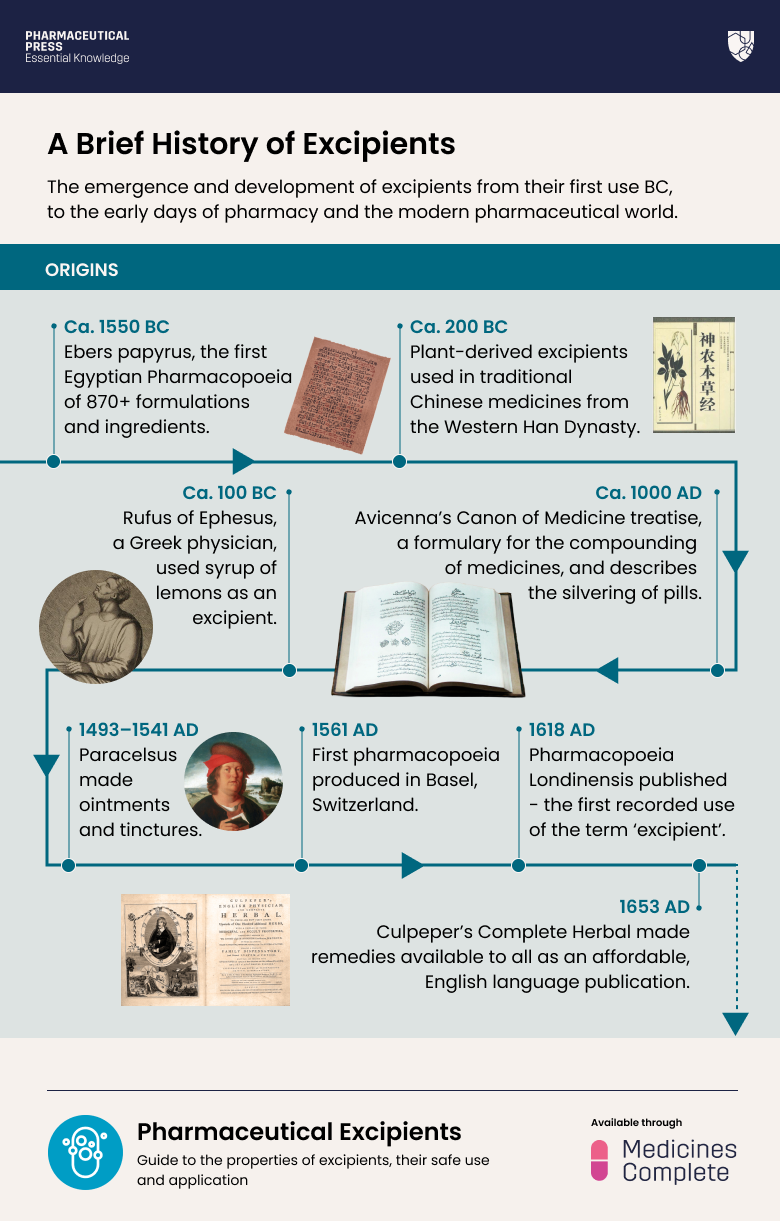
The history of excipients begins with the creation of the Ebers papyrus (in around 1500 BC) and runs to the present day.
The content of this article has been taken from Pharmaceutical Excipients. For a guide to the properties of excipients, their safe use and application, access Pharmaceutical Excipients via MedicinesComplete.
Please complete the form at the bottom of this article to request a complimentary trial of MedicinesComplete.
Origins
The Ebers Papyrus (1500 BC)
- The Ebers papyrus is an early medical text named after George Ebers, a German Egyptologist, who acquired it in 1875. It is often regarded as the first pharmacopoeia (Bryan 1930)
- Ebers papyrus records over 870 formulations prepared using some 700 medical compounds. The majority of these compounds were derived from animal and vegetable sources, although some minerals were included
- Wines, beers, and milk were used as vehicles for liquid formulations. Honey was used as an excipient in draughts, poultices, suppositories, and pills. Animal and bird fats, together with olive oil, were used to prepare liniments, suppositories, and salves. Breadcrumbs were also used in other formulations.
Origin of the Term: Excipient
- The word excipient originates from the Latin excipere, meaning to except, explained in this context as ‘other than’ the active component of the formulation
- The earliest known usage of the term is in the first Pharmacopaeia Londinensis, which was published in 1618, and refers to ‘syrup of the fruit of lemons’. This excipient was used in the preparation of a pill attributed to Ruffus of Ephesus (ca. 100 BC), and this formulation was still in use in 1914 (Kirkby 1939)
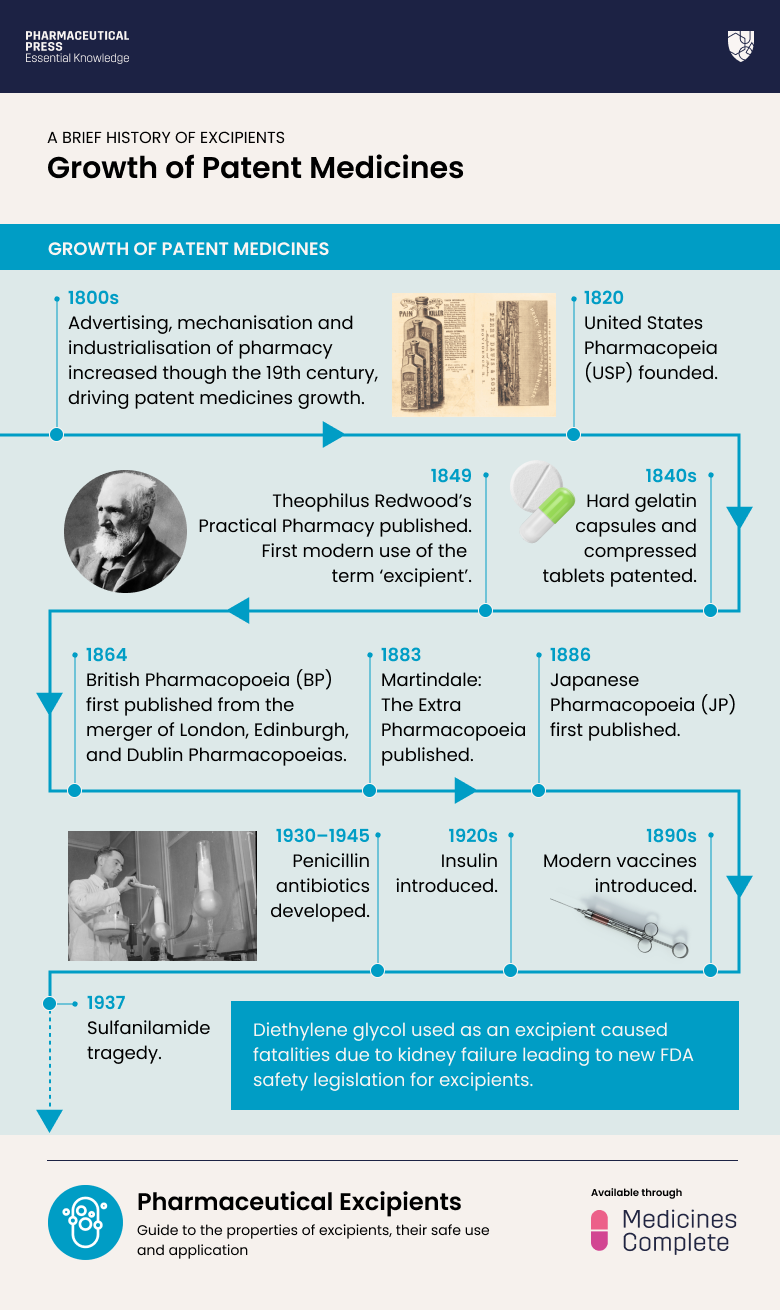
- The term excipient was first used in the modern sense by Theophilus Redwood in 1849, with specific reference to ingredients used in pills (Mohr, Redwood 1849).
The definition of an excipient is ‘a therapeutically inactive ingredient added to a formulation to aid the manufacture of the final dosage form, to promote its stability, or to enhance its performance’.
Materia medicas and Pharmacopoeias
- Prior to the 1800s almost all medicines and excipients were derived from natural products. Over the centuries, various treatises were written listing their uses, characteristics, cultivation, harvesting, and storage. Officially known as materia medica, and colloquially as ‘herbals’, these included De Materia Medica by Dioscondes (50-100 AD) and the Herbal of Apuleius (ca. 600 AD)
- Probably the most famous materia medica was the Complete Herbal written by Nicholas Culpeper in 1653. Listing over 400 plants, it provided details on making extracts from these materials and described numerous pill formulations, ointments, and plasters
- Gradually, over the next century, many official pharmacopoeias were published with more substances added. For example, the 1667 edition of the London Pharmacopoeia introduced Peruvian bark used in the treatment of malaria, and benzoic acid to prevent infection. In 1721, sulfated potash for urinary problems, and ferrous sulfate to treat anaemia were added.
The Growth of Patent Medicines (1812-1914)
- In 1812, 552 medical preparations were listed in a UK Act of Parliament that described excise duties (Corley 1987)
- Advertising in the mid-1800s fuelled popular demand for medicines, and sales in the UK rose to £600,000. This had increased to £3 million by 1871 and to £5 million by 1914 (Jepson 2003)
- At the turn of the century in 1908, the number of patent medicines sold in the UK exceeded 41 million items (BMA 1909). Similarly, in the US, manufacture of patent medicines rose by 416% between 1890 and 1904, representing an overall increase of 2130% compared to mid-1800s levels of manufacture (Corley 1987)
- This tremendous growth in the use of patent medicines stimulated an interest in excipients and mass production of medicines.
Mechanisation and Industrialisation (1800-1914)
- Prior to the late 1800s, all medicines were made in small batches by hand with limited mechanisation
- With the start of industrialisation, entrepreneurs, such as Brandreth in the US and Beecham in the UK, employed steam engines and waterpower to mix ingredients together
- Machinery quickly advanced, with the invention of compression techniques, for pills and then tablets, and subsequently the design of machines with rotating turrets and multiple dies in the 1870s that enabled faster and more reproducible manufacture of compressed tablets
- Likewise, developments in the machinery for making hard gelatin capsule shells enabled the Eli Lilly Company of Indianapolis to increase its output from 112 million units in 1910 to 650 million units in 1919 (Jones 2004).
Pills versus tablets (1800s)
- Pills are created by mixing the active ingredient(s) and excipients together to form a paste. The paste is then formed into a ball or pellet. After drying this may be coated with a lacquer to enhance the appearance or to mask an unpleasant taste
- Tablets are manufactured by compressing a blend of dry powders in a metal die. The industrial revolution enabled the mass production of tablets and contributed to the widespread popularity of patent medicines in the western world
- As a result, the number of pill formulations described in the major pharmacopoeias has steadily declined since the first London Pharmacopoeia was published in 1618.
Aids to Formulation (1840-1900)
- By the mid-1800s changes in education, regulation, professional literature, manufacturing, and science were quite evident
- In 1849, Theophilus Redwood published a treatise intended to be a comprehensive work on pharmaceutical technology for pharmacists (Mohr, Redwood 1849). This was based on an earlier work in German by Frederich Mohr, (Mohr 1847) and was subsequently enlarged for the US audience by William Procter Jnr (Procter 1849). Redwood’s text was the first to use the word excipient in the modern context and included lists of excipients used in a wide range of formulations. Redwood was also the first to discuss the concept of excipient functionality, in relation to the stability, adhesiveness, firmness, and plasticity of the pill mass.
First Comprehensive List of Tablet Excipients (1914)
Based on data from patents, research publications, and experience, Lyman Kebler, of the Drug Division of the Bureau of Chemistry, US Department of Agriculture, published the first comprehensive list of tablet excipients in 1914 (Kebler 1914).
The excipients were listed under the headings of liquids, adhesives, bases, disintegrators, adsorbents, lubricants, and fillers.
- Adhesives included acacia, cane sugar, dextrin, flour, milk sugar, gelatin, glucose, Irish moss, and tragacanth
- Adsorbents included magnesium carbonate, milk sugar, powdered liquorice, and starch
- Bases included ammonium chloride, cane sugar, citric acid, milk sugar, ammonium chloride, sodium carbonate, and sodium chloride
- Disintegrators included gelatin and starch
- Fillers included kaolin, fullers earth, and terra alba
- Liquids included ethanol, methanol, mixtures of benzine (sic)/alcohols, and water
- Lubricants included boric acid, liquid petrolatum (white oil), starch, stearic acid, talc, and Theobroma oil.
Formulation Innovation
Surface Active Agents (1910-1970)
- Prior to the 1800s, few surface active agents (surfactants) were available for use other than soap used in pills, enemas, and suppositories, and egg used for creams
- During the 1800s, surface activity was generally created in situ by the sulfonation of vegetable oils using sulfuric acid or the use of saponins from Quillaia bark
- The first synthetic surface active sulfonate, sodium lauryl sulfate, was invented in 1916 and introduced into pharmacy in 1940 (Fishburn 1965). Fatty acid esters of sorbitan (Spans and Tweens) were introduced as excipients in the 1950s (Fishburn 1965).
- Recent advances in synthetic chemistry have made available a wide range of surfactants with a variety of properties.
Cellulosic Excipients (1900s)
- Cellulose was discovered in 1838 by the French chemist Anselme Payen who isolated it and determined its chemical formula (Payen 1838)
- The earliest cellulose derivatives (such as celluloid and rayon) were developed in the 1800s (Encyclopaedia Britannica Celluloid, Encyclopaedia Britannica Rayon). Many of the properties of cellulose and its derivatives depend on the degree of polymerisation and degree of substitution
- Ethyl cellulose was first manufactured in 1935, followed by methylcellulose in 1937
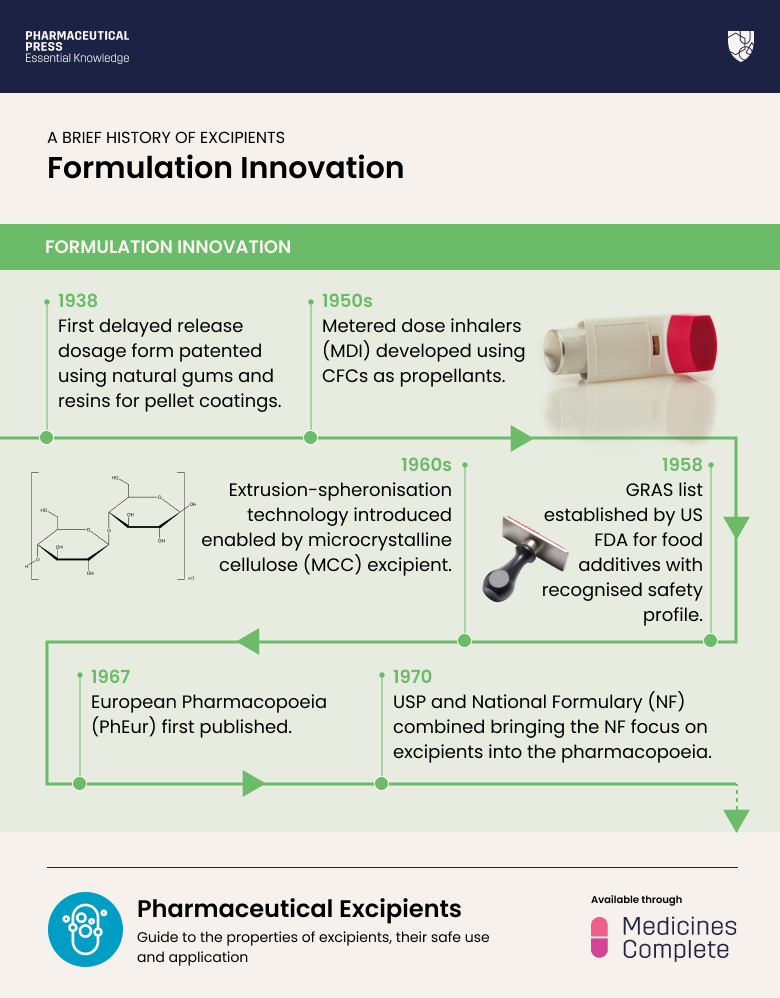
- Microcrystalline cellulose was first developed in the 1950s; it rapidly became one of the most common tableting excipients
- Cellulose esters (such as cellulose acetate phthalate) and cellulose ethers (such as ethylcellulose and hypromellose) found use as film coating polymers and as controlled release matrix formers
- Cross-linking can be used to reduce aqueous solubility and promote swelling; this led to the development of modern tablet superdisintegrants
- Many modern coprocessed excipients also include cellulose derivatives.
Novel Formulations (1930s onward)
The introduction of new routes of delivery and novel formulation types frequently resulted in the introduction of new excipients. Examples include:
- Chlorinated fluorocarbons were used as propellants for metered-dose inhalers (starting in the 1950s) (Sciarra 1986)
- Polyvinylchloride powder was briefly used to manufacture plastic matrix tablets in the 1960s (Rowe 1975)
- Low molecular weight hypromellose (HPMC) was introduced for aqueous film coating of tablets, beginning in the 1970s (Rowe 1992). This excipient is still very widely used
- Penetration enhancers were developed to enable the transdermal delivery of drugs in the 1970s (Finne, Morgan 1999)
- From the 1980s onwards, polylactic acid/glycolic acid copolymers have been developed to enable the creation of bioerodable implants (Athanasiou 1986).
The Modern Era
Scale-up and Excipient Control (1950 to present)
The need to optimise the commercial production of dosage forms for high-speed and high-volume manufacturing drove the introduction of improved excipients, but also necessitated stricter controls on their properties.
For example:
- Different lactose grades have been developed specifically for use in inhalation and tablet formulations
- The molecular weight of hypromellose is carefully controlled to eliminate aqueous film-coating defects on immediate release tablets
- The molecular substitution of cellulose-derived polymers is purposely manipulated to allow users to fine-tune the release rate of drugs from matrix tablets and beads
- Batch-to-batch variability of microcrystalline cellulose properties, such as particle size and pulp source, has been minimised by most manufacturers to ensure a highly consistent product for high throughput tablet production and extrusion/spheronisation operations
- The particle size and crystalline form of magnesium stearate – and therefore its lubrication effectiveness – is very tightly controlled to enable modern high-speed tableting operations..
Health and Safety Concerns (1930s onward)
Health and safety concerns have influenced excipient choice and formulation science:
- 1937 Sulfanilamide tragedy. The use of diethylene glycol as an excipient in an elixir caused multiple deaths due to renal failure and lead to the introduction of new FDA safety legislation for excipients
- 1958 GRAS list established. Food additive regulation led to changes in excipient usage
- 1960s Chloroform toxicity. Chloroform, widely used in formulations prior to the 1950s, was gradually removed from pharmaceutical products due to carcinogenicity concerns
- 1973 Asbestos in talc. US law required medical talc to be asbestos free
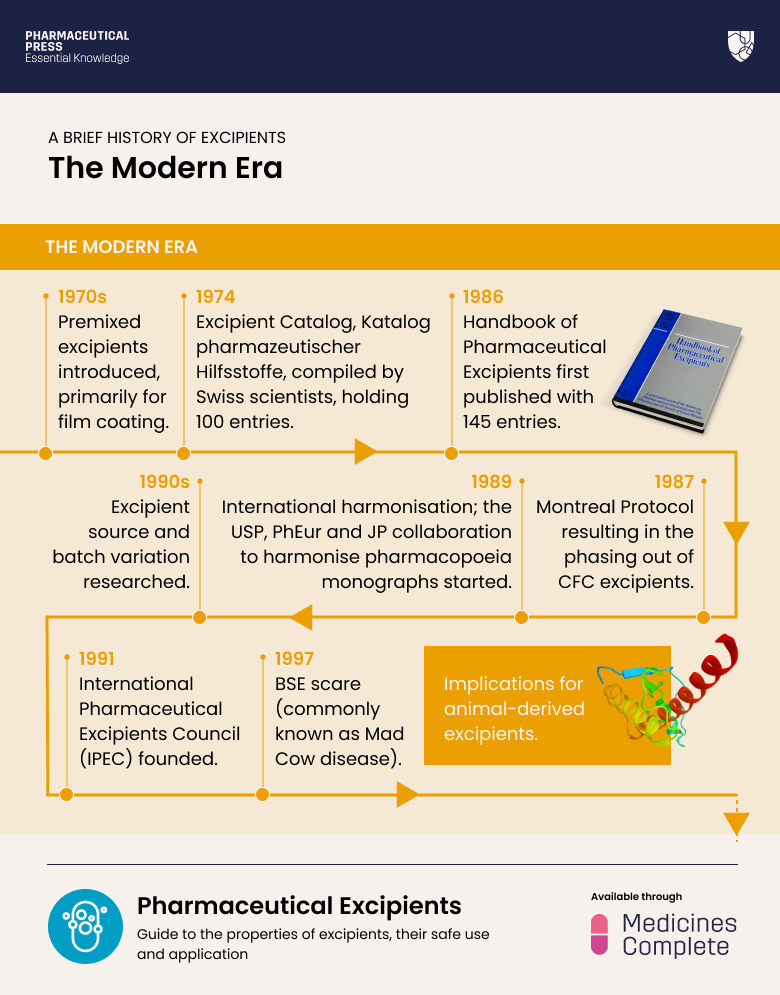
- 1997 Bovine Spongiform Encephalitis (BSE) scare. Products derived from cows and pigs, such as gelatin and stearates, were implicated in the development of a rare human brain disease (variant Creutzfeldt–Jakob disease)
- 2000s Increased awareness of intolerance of certain excipients. The negative effects of certain excipients (for example, colouring agents, propylene glycol, lactose) on some patient groups (such as children, patients with severe allergies) has led to less frequent use or restrictions
- 2010s Nitrosamine formation in drug products. The presence of nitrite impurities in some excipients may contribute to the formation of potentially genotoxic species through the reaction with secondary amine groups (for example, in ranitidine drug products).
Environmental Issues (1970s onwards)
The environmental effect of ingredients has also changed approaches to formulation:
- 1970s Organic solvents. Awareness of the harmful effect of chlorinated hydrocarbons, such as methylene chloride, led to less frequent use of such solvents for tablet film coating and the introduction of water-soluble film-coating polymers
- 1982 Moratorium on sperm whale hunting. Naturally derived excipients, such as spermaceti and cetostearyl alcohol, were replaced by synthetic excipients in the formulation of creams and ointments
- 1987 Montreal Protocol. Chlorinated fluorocarbon (CFC) propellants for aerosols were found to have a damaging effect on the ozone layer. Hydrofluorocarbons (HFCs) were introduced as replacement propellants
- 2019 Global warming. HFCs recognised as having significant global warming potential, and so are being gradually phased out
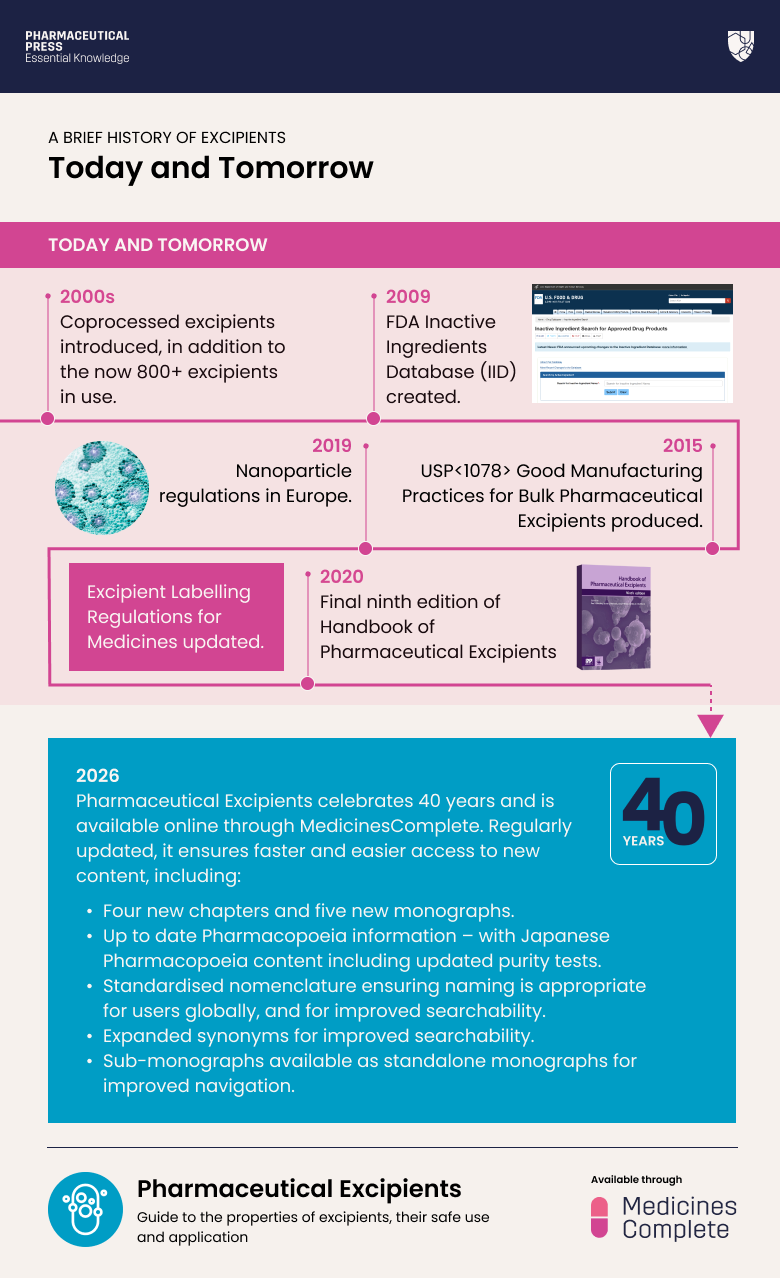
- 2019 Nanoparticles in the environment. Regulations drafted to limit the spread of nanoparticles in the environment. Several excipients, such as titanium dioxide, are included
Data Compilation and Consolidation (1970s onward)
Before 1970, excipient data was spread out across various pharmacopoeias, codices, and scientific papers. An initial consolidation of excipient data occurred when the USP and NF combined in 1970. Harmonisation of excipient monograph content has been a major focus of the modern pharmacopoeias since the 1980s.
In 1974, a typescript document summarising excipient data was produced by scientists from Ciba-Giegy, Hoffman-La-Roche, and Sandoz (Ciba-Giegy 1974). This provided inspiration for the Handbook of Pharmaceutical Excipients, which was first published in 1986 and contained 145 monographs. Its subsequent editions in print and online (Sheskey et al.) have evolved to include over 400 monographs and several informative chapters. Other compilations of excipient data have also been produced (Fiedler 2007, Ash 2007). The FDA Inactive ingredient database was published online in 2009 providing information on excipients included in FDA-approved drugs (FDA).
Advanced Computing Technologies (1980s onwards)
- Prior to 1980, the selection of excipients for formulations was based on heuristics. Advances in computer technologies in the 1980s provided a means of capturing this knowledge and expertise in a form that could be understood by computers. In addition, data mining became more widely available allowing formulation properties and performance to be modelled
- In 1989, the first usable ‘expert system’ was developed for the selection of excipients for tablet formulations (Rowe, Roberts 1998). This was soon followed by the development of expert systems for the design of capsules, film coatings, and parenteral formulations (Rowe, Roberts 1998).
- The 1990s heralded the use of neural networks and genetic algorithms for modelling drug release from tablets (Rowe, Colbourne 2006).
- Computer-aided formulation design based on artificial intelligence was established in the 2000s, with a strong reliance on simulations and data mining (Rowe, Colbourne 2010).
IPEC and Harmonisation (1991 to present)
The International Pharmaceutical Excipient Council (IPEC) was formed in 1991 to help excipient harmonisation efforts.
Founding member companies included Colorcon, GAF (which later became ISP, then Ashland), Hercules (now Ashland), Merck, Sharpe and Dohme, Dow Chemical (now Dupont), Hoffman La-Roche (now Roche) and Servier. IPEC published the first excipient Good Manufacturing Practices guideline in 1995 (IPEC 2008: GMP) and the first guidelines for Safety Evaluation of Excipients in 1997 (IPEC 2020).
The international IPEC Federation was created in 2009 as a global trade organisation that promotes quality in pharmaceutical excipients.
Additional IPEC guidelines include a Good Distribution Practices Guide, an Excipient Qualification Guide, a Certificate of Analysis Guide, the Significant Change Guide for Pharmaceutical Excipients, and a Technically Unavoidable Particle Profile Guide (Ipec 2008: Qualification Guide, IPEC 2017, IPEC 2014, IPEC 2013, IPEC 2008: GMP).
Today and Tomorrow
Modern Approaches: Coprocessed Excipients
- The regulatory approval of new excipients is challenging because of the need to generate comprehensive toxicology data for all new chemical entities that are administered to humans
- An approach that has found favour is to manipulate the properties of existing excipients that have a proven safety profile by coprocessing them. This can create excipients with improved functional properties for a variety of applications.
The coprocessed method uses excipients with a pre-approved safety profile to create novel excipients.
Examples of coprocessed excipients include starch, lactose, and cellulose-based excipients, such as:
- Corn Starch and Pregelatinised Starch, Coprocessed
- Cellulose, Microcrystalline and Carboxymethylcellulose Sodium, Coprocessed
- Lactose Monohydrate and Povidone, Coprocessed.
Future Advances
- In the future, existing excipients will undoubtedly find new uses. For example, for intranasal drug delivery or as components of new coprocessed excipients
- New delivery routes and formulation types will also need different excipients or excipients with different specifications. For example, gene therapies, implants, 3D printed dosage forms, or nanoparticle formulations
- A greater understanding of excipient minor components (e.g., residual solvents, nitrates, peroxides) will drive new excipient regulations. In turn this will cause an evolution of excipient specifications and manufacturing processes
- Improved analytical techniques (e.g., spectroscopy) will provide a much better understanding of excipient properties and their functionality. Spectroscopic data is now routinely included in this publication’s monographs.
Trial form
Please complete the form below to request a complimentary trial to knowledge products through MedicinesComplete.
References
- Ash M, Ash I. Handbook of Pharmaceutical Additives, 3rd edn. Endicott, NY: Synapse Information Resources, 2007.
- Athanasiou KA et al. Sterilization, toxicity, biocompatibility and clinical application of polylactic acid and polyglycolic acid copolymers. Biomaterials 1986; 17(2): 93–102.
- British Medical Association. Secret remedies – what they cost and what they contain. London: British Medical Association, 1909: 182-184.
- Ciba-Geigy AG, Hoffmann-La Roche F, Sandoz AG. Katalog pharmazeutischer Hilfsstoffe. Basel, Switzerland, 1974.
- Corley TAB. Interactions between the British and American patent medicine industries 1708-1914. Bus Econ His 1987; 16: 111–129.
- Encyclopedia Britannica, eds. Encyclopedia Britannica: Celluloid: synthetic plastic. https://www.britannica.com/technology/celluloid (accessed 4 March 2020).
- Encyclopedia Britannica, eds. Encyclopedia Britannica: Rayon: textile fibre. https://www.britannica.com/technology/rayon-textile-fibre (accessed 4 March 2020).
- Fiedler HP et al. Fiedler Encyclopedia of Excipients [online]. Wissenschaftliche Verlagsgesellschaft: Stuttgart. http://www.drugbase.de.
- Finnin BC, Morgan TM. Transdermal penetration enhancers: Applications, limitations, and potential. J Pharm Sci 1999; 88(10): 955–958 .
- Fishburn AG. An introduction to pharmaceutical formulation. Oxford: Pergamon Press, 1965: 48-52; 57–58.
- Food and Drug Administration. Inactive Ingredients Database. accessdata.fda.gov/scripts/cder/iig/index.cfm.
- Jepson MH. 12. From secret remedies to prescription medicines: a brief history of medicine quality. In: Anderson S, ed. Making medicines – a brief history of pharmacy and pharmaceuticals. London: Pharmaceutical Press, 2003: 234.
- Jones BE. The history of the medicinal capsule. In: Podczeck F, Jones BE, eds. Pharmaceutical Capsules, 2nd edn. London: Pharmaceutical Press, 2004: 15.
- Kebler LF. The tablet industry – its evolution and present status. J Am Pharm Assoc 1914; 3: 820–845; 937–958; 1062–1099.
- Kirkby W. The story of the pill. Chemist & Druggist 1939; 139(3098): 679–682.
- International Pharmaceutical Excipients Council. The joint IPEC-PQD Good Manufacturing Practices audit guideline: For pharmaceutical excipients, 2008.
- International Pharmaceutical Excipients Council. About us: History. ipec-europe.org/history.html (accessed 3 March 2020).
- International Pharmaceutical Excipients Council. The IPEC good distribution guide for pharmaceutical excipients, version 2, 2017.
- International Pharmaceutical Excipients Council. The IPEC significant change guide, version 3, 2014.
- International Pharmaceutical Excipients Council. The IPEC certificate of analysis guide, 2013.
- Mohr F, Redwood T. Practical pharmacy. The arrangements, apparatus, and manipulations of the pharmaceutical shop and laboratory. London: Taylor, Walton, and Maberly, 1849: 347-353.
- Mohr F. Lehrbuch der pharmaceutischen Technik: fur Apotheker, Chemiker, chemische, Fabrikanten, Aerzte und Medicinal-Beamt. Braunshweig: F Vieweg 1847.
- Payen A. [Memoir on the composition of the tissue of plants and of woody (material)]. Comptes rendus 1838; 7: 1052–1056[in French].
- Procter W Jr, ed., Mohr F, Redwood T. Practical pharmacy. The arrangements, apparatus, and manipulations of the pharmaceutical shop and laboratory, edited, with extensive additions, by William Procter, Jr. Philadelphia: Lea & Blanchard, 1849.
- Rowe RC, Roberts RJ. Intelligent software for product formulation. London: Taylor & Francis Ltd, 1998:133–155.
- Rowe RC, Colbourn EA. Computers in pharmaceutical formulation. In: Ekins S, ed. Computer applications in pharmaceutical research and development. Hoboken, NJ : Wiley-Interscience 2006: 679-701.
- Rowe RC, Colbourn EA. Data mining methods in pharmaceutical formulation. In: Balakin KV, ed. Pharmaceutical data mining approaches and applications for drug discovery. Hoboken, NJ: John Wiley & Sons, 2010: 401-421.
- Rowe RC. Sustained release plastic matrix tablets. Manuf Chem Aer News 1975; 46: 23–26.
- Rowe RC. Defects in film coated tablets – etiology and solutions. In: Ganderton D, Jones T, eds. Advances in Pharmaceutical Sciences, 1992. London, Academic Press: 65-100.
- Sciarra JJ. Pharmaceutical aerosols. In: Lachman L. et al. The theory and practice of industrial pharmacy, 3rd edn. Philadelphia: Lea & Febiger, 1986. 581-618.
- Sheskey PJ, Hancock BC, Moss G, eds. Pharmaceutical Excipients [online]. London; Washington, DC: Pharmaceutical Press; American Pharmacists Association. http://www.medicinescomplete.com/.
- International Pharmaceutical Excipients Council. Qualification of excipients for pharmaceutical use, 2008.
- Bryan CP. The Papyrus Ebers. London: Geoffrey Bles, 1930.
General References
IPEC. IPEC’s global structure. https://ipec-federation.org (accessed 20 May 2020).
Mol. Biophysics, Oxford Univ. Digital image: 3D modelling of proteins on computer.https://wellcomecollection.org/works/kewe74ch (accessed 20 May 2020).
Wellcome Collection. Digital image: G. Ebers (ed.), Papyros Ebers, 1875. https://wellcomecollection.org/works/mvv8scjq (accessed 20 May 2020).
Wellcome Collection. Digital image: Pharmacopoea Londinensis, in qua medicamenta antiqua et nova usitatissima, sedulo collecta, accuratissime examinata, quotidiana experientia confirmata, describuntur.. https://wellcomecollection.org (accessed 16 October 2020).
Wellcome Collection. Plants and herbs from Culpeper’s ‘Complete Herbal…’ From top right, Pellitory of the Wall, Periwinkle, Pepper-wort, Pimpernel, Plantain, Polypody, White Poppy, Corn Rose Poppy and Primrose. https://wellcomecollection.org (accessed 20 May 2020).