


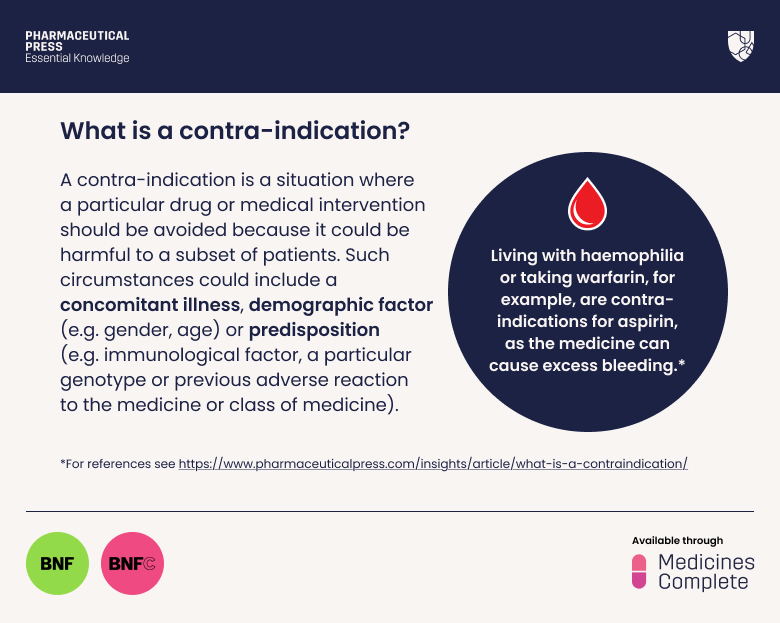
What is a contraindication?What is a contra-indication?
A contra-indication is a situation where a particular drug or medical intervention should be avoided for safety reasons. Such circumstances could include a concomitant illness, demographic factor (e.g. gender, age) or predisposition (e.g. immunological factor, a particular genotype or previous adverse reaction to the medicine or class of medicine) or other drugs a person is taking. Living with haemophilia or taking warfarin, for example, are contra-indications for aspirin, as it can cause bleeding.¹
Please complete the form at the bottom of this article to request a complimentary trial of MedicinesComplete.
The different types of contra-indication
Contra-indications are circumstances in which a particular drug could be harmful to a patient or a subset of patients.¹ There are two types of contra-indication: relative and absolute.²
- A relative contra-indication means health professionals should be cautious when prescribing a medicine in a specific situation. The medicine can be used, but only if the benefits clearly outweigh the risks, and if specified precautions are taken.² ³ This is sometimes referred to as a caution.³
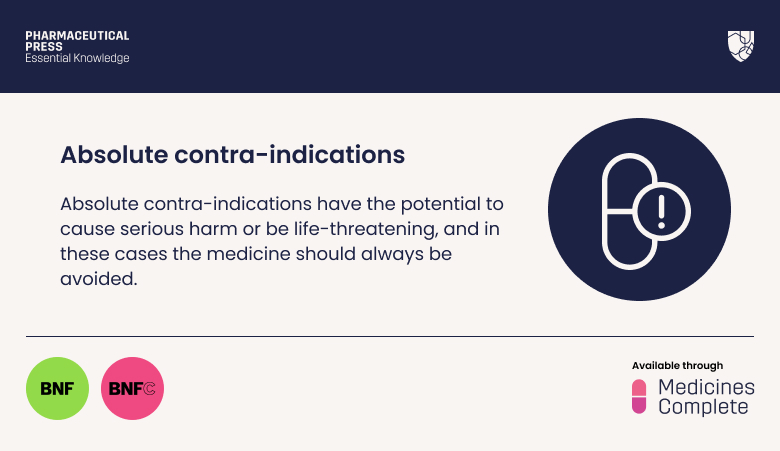
- Absolute contra-indications have the potential to be life-threatening, and in these cases the medicine should always be avoided.² ³ ⁴
To find out when a medicine might be contra-indicated, health professionals should consult the product Summary of Product Characteristics⁴ and/or the British National Formulary (BNF) monograph sections on Contra-indications, Cautions and Side-effects for the relevant drug.
Prescribing a drug for a patient in whom it is contra-indicated is considered a type of medication error.⁵ Avoidable adverse drug events are a significant cause of morbidity and mortality, estimated to cause or contribute to more than 1,700 deaths a year in England alone.⁶
Errors in prescribing are known to account for a high proportion of these events.⁷ There is a lack of data, however, on how often inappropriate prescribing of contra-indicated drugs is involved; one study found that contra-indications and drug interactions were a common theme with medication errors reported by junior hospital doctors.⁸ Fortunately many of these errors will be identified before the medicine reaches the patient, resulting in ‘near misses.’
Factors involved in drug contra-indications
How a person responds to a drug depends largely on its pharmacokinetics (PK) and pharmacodynamics (PD).
Factors such as age, gender, smoking status, co-morbidities, genetic makeup, and other medication use, can potentially influence the pharmacokinetics and pharmacodynamics of a medicine once it is in the body. All of these considerations, then, can result in a medicine being contra-indicated in a given patient.
Examples of drug contra-indications
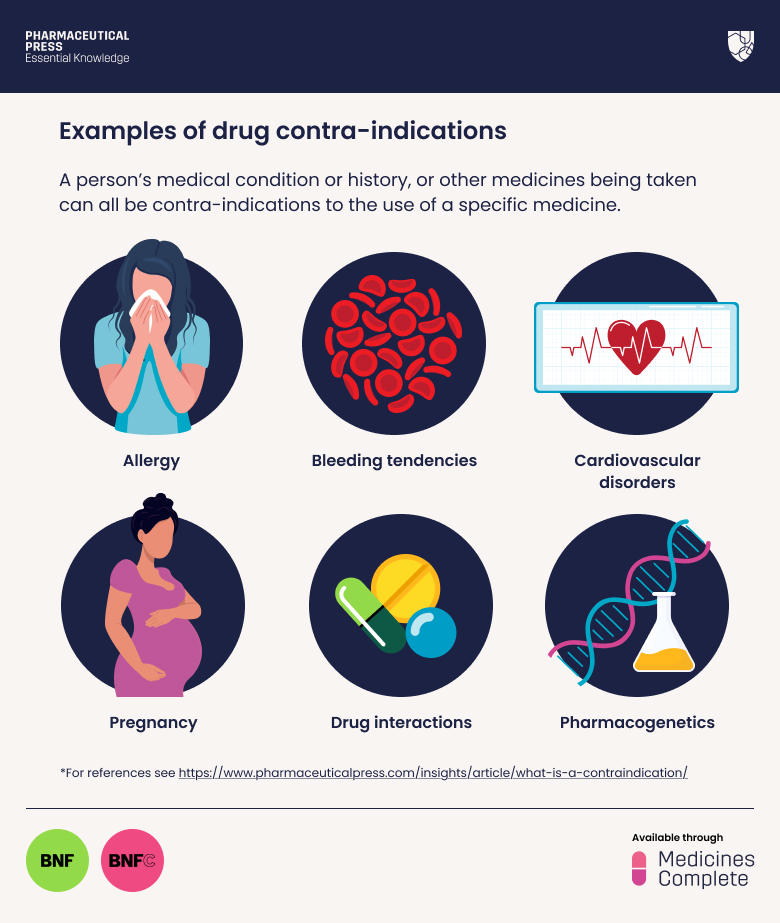
As discussed, a person’s medical condition or history, or other medicines being taken can all be contra-indications to the use of a specific medicine.
Some examples are:
- Allergy
Some people are allergic to certain drugs due to an immunological mechanism, usually involving immunoglobulin E. Signs of an allergic drug reaction are wide-ranging and include rash, pruritus or itching, angioedema, bronchospasm, and anaphylaxis. Anaphylaxis, though rare, is life threatening.⁹
Many drugs have the potential to cause allergic reactions. Drug classes commonly implicated include penicillins, cephalosporins and sulfonamide-containing antibiotics, muscle relaxants, vaccines, angiotensin-converting enzyme (ACE) inhibitors, and nonsteroidal anti-inflammatory drugs (NSAIDs). Penicillin is the most common drug cause of anaphylaxis. Allergic reactions can also occur with chemotherapy drugs and monoclonal antibodies.¹⁰
Medicines are still inadvertently prescribed to people who have a clearly documented allergy.¹¹ All health professionals must have an awareness of the problems of drug allergy and pharmacists have a particular role in checking drug allergy status.¹²
- Bleeding tendencies
Some medicines, such as aspirin, clopidogrel, and anticoagulants, interfere with platelet function or blood clotting.¹³
This contra-indicates their use in people who are actively bleeding, who have haemophilia or other bleeding disorders, or severe liver disease including oesophageal varices. NSAIDs are contra-indicated in people with an active peptic ulcer or with a history of peptic ulceration or active gastrointestinal bleeding.
- Cardiovascular disorders
Caution is needed with many prescribed medicines in patients with cardiovascular disorders such as coronary artery disease, arrhythmias, heart failure, hypertension, and angina and some are contra-indicated.⁴ ¹⁶ For example, cardiogenic shock and sick sinus syndrome are absolute contra-indications to the use of beta-blockers.
Statins are contra-indicated in people with active liver disease or unexplained persistent elevations of serum transaminases, when these levels exceed three times the upper limit of normal. Some medicines, such as decongestants (e.g. pseudoephedrine) and central nervous system (CNS) stimulants (e.g. methylphenidate) can increase blood pressure, so they may not be suitable for people with severe or uncontrolled hypertension.⁴ ¹⁴ ¹⁵
- Pregnancy
Drugs can have harmful effects on the embryo or fetus when used during pregnancy, so it is important to consider this with medicines use in women of childbearing potential or for men trying to father a child. During the first trimester drugs can produce congenital malformations (teratogenesis) and during the second and third trimesters they can affect fetal growth or functional development.
One particularly important example of a drug contra-indicated in pregnancy is valproic acid, or valproate.¹⁶ Valproate, used in epilepsy and bipolar disorders, is highly teratogenic: use in pregnancy can lead to neurodevelopmental disorders and congenital malformations. It is imperative that health professionals ensure guidance from the Medicines and Healthcare products Regulatory Authority on its use is followed.
- Drug interactions
Drug interactions occur when the effect of one medicine is altered by the co-administration of another drug, food, or herbal product.¹⁷ Often the effect of such an interaction is not clinically significant and occasionally it can be beneficial. Drug interactions can also, however, be clinically significant, requiring action to avoid harm. In some cases, the interaction may cause serious harm or therapeutic failure, such that co-administration of the two products is an absolute contra-indication. For example, rifampicin is a known inducer of liver enzymes and may reduce the efficacy of systemic hormonal contraceptives. Patients on oral contraceptives should be advised to use alternative, non-hormonal methods of birth control during rifampicin therapy.
- Genetic predisposition
People respond differently to medicines and it is increasingly recognised that this is influenced by genetic factors. Pharmacogenomics is the study of how a person’s unique genetic profile affects the response to medicine. An example of how this relates to drug contra-indications is the hypersensitivity reaction that can occur with abacavir, used in HIV infection.¹⁸
This reaction is characterised by fever and/or rash with the potential for multi-organ involvement, with rare fatal outcomes. The risk is high for patients who have the HLA-B*5701 gene. Prescribing information states that patients should be tested for this gene before starting treatment and if the gene is present abacavir is contra-indicated.
- Previous adverse drug reactions
Medicines are a common cause of a rare, serious hypersensitivity reaction involving the skin known as Stevens-Johnson syndrome (SJS). Drugs associated with SJS include some antibiotics, antiepileptics, and NSAIDs. A medicine suspected of causing SJS in a patient is strictly contra-indicated at any time afterwards.¹⁹
How to find out about contra-indications
To avoid harm when prescribing, the drug chosen for a particular condition should minimise the patient’s susceptibility to adverse effects and have minimal detrimental effects on any co-morbidities.³
Health professionals can find information on drug contra-indications in BNF monographs. Details are also listed in the product’s prescribing information i.e. summary of product characteristics and patient information leaflets. There is, however, some evidence in the literature that manufacturer’s product information on contra-indications can be ambiguous and may therefore sometimes be ignored in clinical decision making.²⁰ This can have adverse consequences for the patient.
Clinical guidelines are often a useful source of information on alternative medicines that may be used when a medicine is contra-indicated. Stockley’s Drug Interactions is a comprehensive source of information on drug interactions.
Conclusion
Taking into account the contra-indications to the use of a medicine or intervention is a crucial component of safe and effective healthcare. Understanding the rationale for why a medicine should not be used helps health professionals to make informed decisions, ensuring that medicines are not used when there is an absolute contra-indication and are carefully monitored when caution is needed. This will optimise medication use and protect patients from harmful adverse drug events.
Consulting reliable resources, such as the BNF and product-specific information, ensures contra-indications are adequately considered in the delivery of high quality, patient-centred care.
Trial form
Please complete the form below to request a complimentary trial to knowledge products through MedicinesComplete.
References
1. European Medicines Agency. A guideline on Summary of Product Characteristics (2009). https://health.ec.europa.eu/system/files/2016-11/smpc_guideline_rev2_en_0.pdf. (Accessed: 15 June 2026).
2. MedlinePlus (2023). Contraindication. Available at: https://medlineplus.gov/ency/article/002314.htm (Accessed: 15 June 2026).
3. How to use BNF and BNFC online | About | BNF | NICE (Accessed: 15 June 2026).
4. For more information, Electronic Medicines Compendium (emc) | Pharmaceutical Press.
5. Hughes, R. (2008). Patient safety and quality: An evidence-based handbook for nurses. [ONLINE]. Available at: https://www.ncbi.nlm.nih.gov/books/NBK2656/ (Accessed: 19 June 2026).
6. Elliott, R. A., Camacho, E., et al. (2021). Economic analysis of the prevalence and clinical and economic burden of medication error in England. BMJ Quality & Safety, 30(2), 96-105.
7. WHO. (2023). Medication without harm. Available at: https://iris.who.int/bitstream/handle/10665/376212/9789240062764-eng.pdf. Last accessed: 14 June 2026.
8. Lewis, P. J., Ashcroft, D. M., Dornan, T., Taylor, D., Wass, V. & Tully, M. P. (2014). Exploring the causes of junior doctors’ prescribing mistakes: a qualitative study. British Journal of Clinical Pharmacology, 78(2), 310-9. https://dx.doi.org/10.1111/bcp.12332.
9. Abou Daya M and Du Toit G. Anaphylaxis: symptoms, causes and diagnosis. Pharmaceutical Journal, 28 July 2020.
10. Villarreal-González RV, González-Díaz S, Vidal-Gutiérrez O, et al. Hypersensitivity reactions to anticancer chemotherapy and monoclonal antibodies: Safety and efficacy of desensitization. J Oncol Pharm Pract. 2024 Jul;30(5):811-822. doi: 10.1177/10781552231189461. Epub 2023 Jul 24. PMID: 37489025.
11. NHS Resolution Anti-infective medication errors. Anti-infective medication errors – NHS Resolution 16 August 2022 (Accessed: 15 June 2026).
12. Drug allergy: diagnosis and management | Guidance | NICE NCG183, 03 September 2014 (Accessed: 15 June 2026).
13. Bleeding disorders – Living with bleeding disorders | Guy’s and St Thomas’ NHS Foundation Trust (Accessed: 15 June 2026).
14. American Heart Association. (2024). High Blood Pressure That’s Hard to Treat. Available at: https://www.heart.org/en/health-topics/high-blood-pressure/the-facts-about-high-blood-pressure/resistant-hypertension–high-blood-pressure-thats-hard-to-treat (Accessed: 15 June 2026).
15. BNF. (n.d.) Available at: www.medicinescomplete.com (Accessed: 16 June 2026).
16. Valproate – reproductive risks – GOV.UK (Accessed: 16 June 2026).
17. Specialist Pharmacy Service. Understanding drug interactions – NHS SPS – Specialist Pharmacy Service – The first stop for professional medicines advice (Accessed: 16 June 2026).
18. Pirmohamed M and Rollison V, Chapter 3 Pharmacogenetics, in Adverse Drug Reactions Third edition, Lee A and Cuthbert M (eds), Pharmaceutical Press 2023.
19. Clifford D, Michlewska S, Skwarski J, Chapter 5 Drug-induced cutaneous reactions, in Adverse Drug Reactions Third edition, Lee A and Cuthbert M (eds), Pharmaceutical Press 2023.
20. Andrikyan, W., Sponfeldner, M. I., Jung-Poppe, L., et al. Physicians’ and pharmacists’ perspective on clarity and clinical relevance of absolute contraindications in “Summaries of Product Characteristics”. Br J Clin Pharmacol. 2025;91(3):829-840. doi:10.1111/bcp.16331