



What is ulcerative colitis?
Ulcerative colitis (UC) is a chronic inflammatory bowel disease (IBD) characterised by inflammation and ulceration of the mucosa in the rectum and colon.¹ ² The lifelong condition affects an estimated five million people worldwide, with incidence continuing to increase globally.²
UC is the most common form of IBD.³ Given its prevalence and potential to impact a patient’s quality of life, it is important that health professionals understand the treatment approach.
This article provides an overview of UC, including its symptoms, diagnosis and management, and discusses how health professionals can support optimal clinical outcomes.
Please complete the form at the bottom of this article to request a complimentary trial of MedicinesComplete.
UC most commonly presents between the ages of 20 and 40 years, although diagnosis can be made at any age.² ⁴ The exact cause is still unknown, although environmental and immune factors, and genetic predisposition are all thought to be involved.² ⁴
UC has a relapsing-remitting pattern, with mild or no symptoms for a period of time (termed remission) and then episodes of more severe symptoms, or ‘flare-ups’.⁵ The symptoms vary in severity depending on the extent of inflammation and disease activity. However, the most common symptoms are:⁴
- Diarrhoea (soft stool and an increased frequency of defecation)
- Rectal bleeding
- Abdominal pain and cramping
- Faecal urgency and incontinence
- Tenesmus (a persistent, painful urge to pass stool even when the rectum is empty)
- Fatigue.
As many of these symptoms occur in other gastrointestinal conditions, further assessment is necessary to confirm an UC diagnosis. There are several manifestations of UC that occur outside the gastrointestinal tract; these include aphthous ulcers, episcleritis, arthropathy and anterior uveitis. Because flare-ups are unpredictable, living with UC can cause anxiety and stress.⁶ There is no cure, so the aim of treatment is to control symptoms to allow people to have the best possible quality of life.⁶ ⁷
Diagnosis
Diagnosis of UC relies on a combination of clinical history, non-invasive biomarkers of inflammation, imaging and histology.² ⁸
A comprehensive medical history and physical examination should explore specific symptoms and risk factors. There are usually persistent gastrointestinal symptoms: diarrhoea (more than 90% of patients have rectal bleeding); abdominal pain, particularly in the left lower quadrant; and unintentional weight loss is a feature of more severe disease.⁶ Patients may have abdominal tenderness or distension, nutritional deficiencies and pallor.⁶
A range of investigations is required to assist diagnosis, including:² ⁴ ⁷ ⁸
- Stool culture to exclude bacterial infection (e.g. Clostridium difficile, Salmonella, Escherichia coli)
- Blood tests for anaemia and markers of systemic inflammation such as erythrocyte sedimentation rate (ESR) and C-reactive protein (CRP)
- Faecal calprotectin, a non-invasive test with high sensitivity for gastrointestinal inflammation. This is also used to assess response to therapy and relapse, although it cannot differentiate between UC and Crohn’s disease
- Non-invasive imaging, such as abdominal X-ray, CT or ultrasound examination, may help to define the extent of disease
- Endoscopy with biopsies is the most sensitive and specific tool to establish a diagnosis of UC
- In patients presenting with acute severe colitis, flexible sigmoidoscopy during the acute phase is recommended
- Colonoscopy is recommended for all patients with suspected IBD.
UC usually affects the rectum and a variable extent of the colon. Inflammation of the rectum is referred to as proctitis, and inflammation of the rectum and sigmoid as proctosigmoiditis.⁷ Left-sided colitis refers to disease involving the colon distal to the splenic flexure. Extensive colitis affects the colon proximal to the splenic flexure, and includes pan-colitis, where the whole colon is involved.
Ulcerative colitis vs Crohn’s disease
Crohn’s disease is another IBD that features flares and remission. However, the presenting symptoms, location, pattern and depth of inflammation help distinguish the two conditions. The table below summarises some of the key differences:⁹ ¹⁰
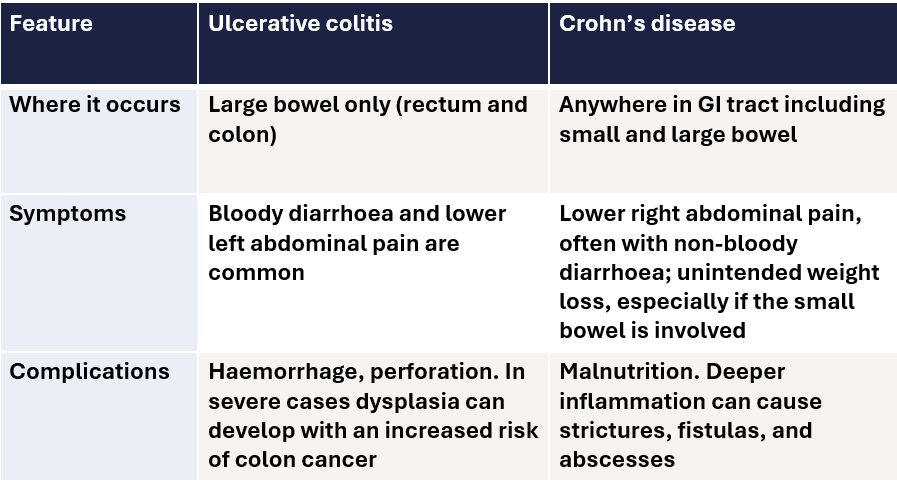
Clinical management
Management of UC is based on clinical severity, extent of disease, and patient preference.⁸ ¹¹
The diagnostic findings are critical as the treatment approach depends on the affected parts of the rectum and colon. Severity is classified as mild, moderate or severe, using disease activity scoring systems such as the Mayo score and the Truelove and Witts’ Severity Index.² ⁶ ⁸
Acute severe ulcerative colitis (ASUC) is the most severe and potentially life-threatening form of UC. Patients generally have ≥6 bloody stools per day and systemic illness (e.g. raised temperature and pulse, low haemoglobin, and elevated inflammatory markers ESR or CRP).² ⁶ These patients should be admitted to hospital for assessment and intensive management.
The treatment goal for patients with active UC is to achieve remission (endoscopic and clinical) by demonstrating complete mucosal healing. The choice of treatment depends on the extent of disease (proctitis, proctosigmoiditis, left sided colitis, extensive colitis), patient factors, previous treatments, and should involve shared decision making with the patient.⁶ ⁸ ¹¹ Maintenance therapies are used after remission.
Aminosalicylates (including mesalazine, sulfasalazine and olsalazine) and topical or oral corticosteroids are the most widely used drugs for inducing remission in people with mild to moderate UC.⁷ ⁸ ¹¹ ¹² ¹³ ¹⁴ The preparation and dosing schedule should be chosen taking into account the delivery characteristics and suitability for the patient. Advanced therapies targeting various immune molecules have become available in recent years and have revolutionised UC treatment by improving quality of life, clinical outcomes and reducing steroid use.⁸ ¹³ The wide range of treatments is a welcome development but can also be a challenge for treatment selection.
Multiple and prolonged corticosteroid courses are associated with significant harm and should be used sparingly, now that advanced therapies are available.¹⁵ Systemic corticosteroids are not recommended for maintenance of remission of UC of any severity.⁶
Medicines that inhibit tumour necrosis factor (TNF)-alpha, including adalimumab, golimumab and infliximab, were the first biological therapies to be used in UC and are now more widely used in moderate to severe disease.² ⁸ ¹¹ ¹⁶
Other targeted treatments include interleukin (IL)-inhibitors (risankizumab, mirikizumab, ustekinumab), integrin receptor antagonists (vedolizumab) and Janus kinase (JAK)-inhibitors. JAK inhibitors (filgotinib, tofacitinib and upadacitinib) and sphingosine 1-phosphate (S1P) receptor modulators, such as ozanimod and etrasimod, are ‘small molecule’ synthetic medicines that are taken orally.
All advanced therapies require specialist management.⁸ ¹⁷ Patients should receive written information before starting treatment. Because of their effects on the immune system, screening to assess the risk of serious and opportunistic infections and the need for vaccinations is also required.
Agilio: Diagnosis and Treatment Guidance, available via Medicines Complete, provides practical clinical guidance for common conditions and symptoms including UC.
The 2019 NICE guideline¹¹ and the more recent British Society for Gastroenterology (BSG) guidelines on IBD,⁸ are the basis of clinical management in adults in the UK. Treatment recommendations are summarised:
Mild to moderate UC
Induction of remission
- Aminosalicylates are the preferred treatment for most patients with mild to moderate UC of any extent
- Mesalazine is a first-line therapy as it is the only aminosalicylate that can be administered topically to the rectum (as suppositories, enemas, or foams)
- Topical mesalazine is preferred over oral administration as it rapidly induces clinical response and remission and has an excellent safety profile
- Combination therapy with topical and oral aminosalicylates can also be used
- Oral corticosteroids are used when aminosalicylates fail to achieve remission. When indicated their use should be limited to 4 to 8 weeks treatment depending on the steroid
- Topical or oral corticosteroids can be used together with aminosalicylates and in people who cannot tolerate aminosalicylates.
Maintenance therapy
- Oral aminosalicylates are recommended for maintenance therapy.
Moderate to severe UC
Induction of remission
- Oral corticosteroids (e.g. prednisolone) have typically been first-line induction treatments
- Biological (e.g. TNF-alpha inhibitors) and targeted therapies are increasingly used, as monotherapy or as part of combination therapy
- An immunosuppressant (e.g. azathioprine, mercaptopurine) is generally given in combination with biological therapy. Immunosuppressant monotherapy is not recommended.
Maintenance therapy
- The drug successful in achieving remission should usually be continued, with the exception of corticosteroids as they are not recommended for maintenance treatment
- Immunosuppressants, biologics and advanced therapies are increasingly used
- Immunosuppressants (e.g. azathioprine or mercaptopurine) can be used alone to maintain remission.
Many of these drug treatments, such as immunosuppressants and advanced therapies, require regular monitoring with laboratory tests to check, for example, full blood count, liver function, faecal calprotectin, and/or anti-TNF drug and antibody levels.
Drug Monitoring Checker, available via Medicines Complete, is an essential tool to support health professionals make effective drug monitoring decisions at the point of care.
Surgery for moderate to severe UC may be needed if medicines no longer control the condition or if they cause intolerable side effects.⁶ Currently around 20% of patients require surgery for refractory disease or if ulcerative colitis leads to complications, such as bleeding, colon rupture or cancer.
Lifestyle, behaviour, and environmental modification are also important for the management of UC. All patients should receive education on the importance of lifestyle changes (e.g., engaging in regular weight-bearing exercise, stopping smoking, avoiding excessive alcohol intake), as well as vitamin D and calcium supplementation.⁶
Conclusion
- UC is a lifelong IBD that can have a significant impact on quality of life with physical and emotional challenges for patients, as work, education and relationships can all be impacted.
- There are multiple considerations in the management of UC, which can be challenging for patients, health professionals and service provision. A wide range of effective treatments is now available, from aminosalicylates, that have been used for decades, to advanced therapies.
- Biological and targeted therapies have revolutionised UC treatment by improving patient quality of life, clinical outcomes and reducing steroid use. These medicines are complex and require specialist management and monitoring. Effective management involving all members of the healthcare team can help reduce disease activity, prevent complications and improve outcomes in people with UC.
Trial form
Please complete the form below to request a complimentary trial to knowledge products through MedicinesComplete.
References
1. Ulcerative Colitis. National Institute of Diabetes and Digestive and Kidney Diseases NIDDK, https://www.niddk.nih.gov/health-information/digestive-diseases/ulcerative-colitis. (Accessed: September 27 2026). https://www.niddk.nih.gov/health-information/digestive-diseases/ulcerative-colitis
2. Le Berre C, Honap S, and Peyrin-Biroulet L, (2023) Ulcerative colitis. The Lancet, 402(10401), pp. 571-584. Available at: https://www.thelancet.com/journals/lancet/article/PIIS0140-6736(23)00966-2/fulltext (Accessed: September 27 2026)
3. CDC US Centers for Disease Control and Prevention. Ulcerative Colitis Basics | IBD | CDC (Accessed: 27 September 2026)
4. National Institute for Health and Care Excellence (NICE) (2026) Ulcerative colitis. Clinical Knowledge Summaries. Available at: Ulcerative colitis | Health topics A to Z | CKS | NICE (Accessed: September 27 2026)
5. Ulcerative Colitis. NHS.UK, 3 Oct. 2018, Ulcerative colitis – NHS https://www.nhs.uk/conditions/ulcerative-colitis/. (Accessed: September 27 2026).
6. Ulcerative colitis – Symptoms, diagnosis and treatment | BMJ Best Practice (Accessed: September 27 2026).
7. MedicinesComplete — CONTENT > BNF > Treatment summary: Ulcerative colitis (Accessed: September 15 2026).
8. Moran GW, Gordon M, Sinopolou V, et al. British Society of Gastroenterology Guidelines on inflammatory bowel disease in adults: 2025. Gut 2025;74:s1–101.
9. Crohn’s UK. Comprehensive Guide to Crohn’s vs Ulcerative Colitis Symptoms (Accessed: September 27 2026).
10. Canadian Digestive Health Foundation. Ulcerative Colitis and Crohn’s Disease: What’s the Difference? Infographic – Canadian Digestive Health Foundation (Accessed: September 29 2026).
11. NICE Guideline 130. Ulcerative colitis: management. Published 3 May 2019. Ulcerative colitis: management
12. Abdulrazeg O, Li B, Epstein J, & Guideline Committee (2019). Management of ulcerative colitis: summary of updated nice guidance. BMJ, 367, l5897. https://dx.doi.org/10.1136/bmj.l5897
13. Butler TD, Segal J, Guideline review: 2025 British Society of Gastroenterology guidelines on inflammatory bowel disease in adults: Part 2 – ulcerative colitis. Frontline Gastroenterology; 0:1-5E pub ahead of print: flgastro-2025-103426
14. Schnoy E, Dignass A, Gaskins M, et al. (2025). From guidelines to evidence-based practice – a German perspective on mesalazine as first line therapy for mild-to-moderate ulcerative colitis. Zeitschrift fur Gastroenterologie, 63(10), 1053-1067. https://dx.doi.org/10.1055/a-2596-8934
15. Feuerstein JD, Rubin DT, Aberra FN, et al. (2025) Appropriate use and complications of corticosteroids in inflammatory bowel disease: A comprehensive review. Clinical Gastroenterology and Hepatology;23:2068–2082
16. Singh S, Loftus EV Jr, Limketkai BN, et al. AGA living clinical practice guideline on pharmacological management of moderate-to-severe ulcerative colitis. Gastroenterology. 2024 Dec;167(7):1307-43
17. Crohn’s and Colitis UK. Drug treatments for Crohn’s Disease and Ulcerative Colitis (Accessed: September 29 2026)