


An introduction to toxicologyWhat is toxicology?
Toxicology is the science of how substances, of natural or synthetic origin, can cause harm to humans, animals, or the environment. It identifies and manages the risk they pose, supporting professionals in healthcare, law, and environmental protection to address harmful exposures.
Toxicology is a broad discipline, that combines knowledge from other fields of study, such as chemistry, genetics, and pharmacology.
There are many sub-disciplines with a specific focus: for example, analytical toxicology underpins many areas of practice, providing evidence to support legal cases, assist health professionals, and protect the environment; tools and techniques such as chromatography and mass spectrometry are used to carry out analysis by separating, identifying, and measuring drugs, poisons, and their metabolites.
In forensic toxicology, analytical methods are applied to case samples for legal investigations, therefore accuracy, reproducibility, and traceability are crucial.
In clinical toxicology, the same techniques are applied to manage patient care, such as confirming medication compliance, to guide dosing for drugs of narrow therapeutic windows, or in the management of poisoning.
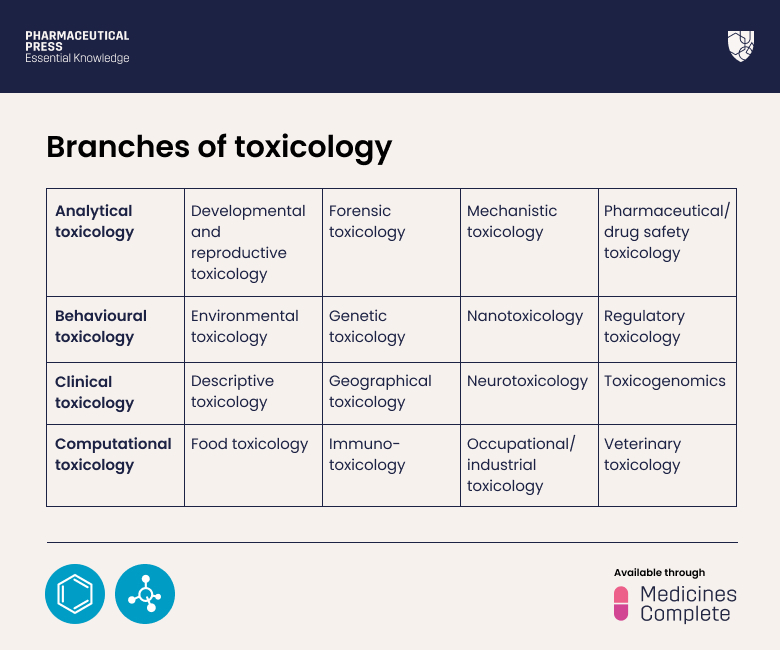
Analytical toxicology also contributes to environmental protection by detecting contamination in soil, water, and air. The table below lists different disciplines that fall under the umbrella of toxicology.
Within these disciplines, challenges may include detecting very low levels of a chemical or analysing an unknown substance. Two widely used resources that support toxicologists navigating these difficulties are Clarke’s Analysis of Drugs and Poisons and Baselt’s Disposition of Toxic Drugs and Chemicals.
Clarke’s Analysis of Drugs and Poisons includes chapters and monographs that explain detailed methods and analytical techniques, making it a leading reference on best practices in analytical and forensic toxicology across laboratories and institutions worldwide. For over 50 years, Clarke’s Analysis of Drugs and Poisons has been a trusted resource for scientists and health professionals. It offers evidence-based information to help users obtain and understand toxicology data in humans for over 2000 drugs and poisons.
Baselt’s Disposition of Toxic Drugs and Chemicals provides a focused support for the interpretation of toxicological data, and for over 40 years has been a go-to resource for information on the pharmacokinetics and pharmacodynamics of drugs and chemicals.
Clarke’s Analysis of Drugs and Poisons and Baselt’s Disposition of Toxic Drugs and Chemicals are available online via MedicinesComplete. Please complete the form at the bottom of this article to request a complimentary trial of MedicinesComplete.
How does toxicology shape regulation?
Toxicology has played a major role in shaping regulations by providing clear evidence about harm, exposure, and risk. The examples below demonstrate how toxicology has helped identify causes of harm and supported the creation of new laws and safety measures.
- Minamata mercury poisoning
The detrimental effects of exposure to mercury have led to new international environmental rules, including the 2013 Minamata Convention on Mercury which was named after Minamata, Japan, where inhabitants suffered mercury poisoning in the 1950s.¹
- Thalidomide disaster
The sedative drug thalidomide was revealed to be the cause of severe birth defects and infant death when taken by pregnant mothers to alleviate morning sickness in the late 1950s.² This led to compulsory safety testing before drug use, tougher drug approval rules, and new medicine regulations worldwide.³
- Lead poisoning
Lead exposure caused more than 3.5 million deaths worldwide in 2023, therefore the WHO promotes legally binding laws to restrict lead in paint and has issued guidelines to prevent and manage lead poisoning.⁴
- Paracetamol overdose
The Prescott regimen was created in the 1970s to treat paracetamol poisoning, and later pack sizes were restricted.⁵ ⁶
- Chicago Tylenol deaths
Cyanide poisoning from tampered capsules (1982) led to efforts to prevent tampering, such as tamper-resistant packaging.⁷
- Anti-doping in sport
Toxicology studies are routinely used to identify and quantify substances that are prohibited in sport,⁸ detect new drugs, and improve testing methods.
How is toxicology relevant today?
Modern toxicology faces new challenges, such as the rise of New Psychoactive Substances (NPS). These designer drugs are made to replicate the effects of illicit drugs and are being manufactured at an alarming rate. Their appearance is growing rapidly along with their chemical structures, leading to a lack of established toxicology profiles.
Because there is often little data on NPS, toxicologists use advanced techniques and reference materials to interpret results. As new challenges come up, regulations need to adapt. Ongoing toxicology research keeps us updated on the potency, toxicity, and harm of substances, emphasising the need to keep analytical methods current.
Trial form
Please complete the form below to request a complimentary trial to knowledge products through MedicinesComplete.
References
- United States Environmental Protection Agency (2025). Minamata Convention on Mercury. https://www.epa.gov/international-cooperation/minamata-convention-mercury#:~:text=Reduce%20and%20where%20feasible%20eliminate,Additional%20Resources (accessed 21 November 2025).
- Rehman W, Arfons LM, Lazarus HM (2011). The rise, fall and subsequent triumph of thalidomide: lessons learned in drug development. Ther Adv Hematol: 291–308.
- United States Food and Drug Administration (FDA) (2008). FDA and clinical drug trials: a short history. https://www.fda.gov/media/110437/download (accessed 21 November 2025).
- World Health Organisation (WHO) (2026). Lead poisoning. https://www.who.int/news-room/fact-sheets/detail/lead-poisoning-and-health (accessed 05 August 2026).
- Bateman DN, Dear JW (2019). Acetylcysteine in paracetamol poisoning: a perspective of 45 years of use. Toxicol Res (Camb), 8: 489–498. PMID: 31341611
- Greene SL et al (2006). Paracetamol availability and recent changes in paracetamol poisoning: is the 1998 legislation limiting availability of paracetamol being followed? Postgrad Med J, 82: 520–523. PMID: 16891443
- EBSCO (2023). Seven people die after taking cyanide-laced Tylenol. https://www.ebsco.com/research-starters/history/seven-people-die-after-taking-cyanide-laced-tylenol (accessed 21 November 2025).
- World Anti-Doping Agency (WADA) (2025). Laboratories. https://www.wada-ama.org/en/what-we-do/science-medicine/laboratories (accessed 21 November 2025).