



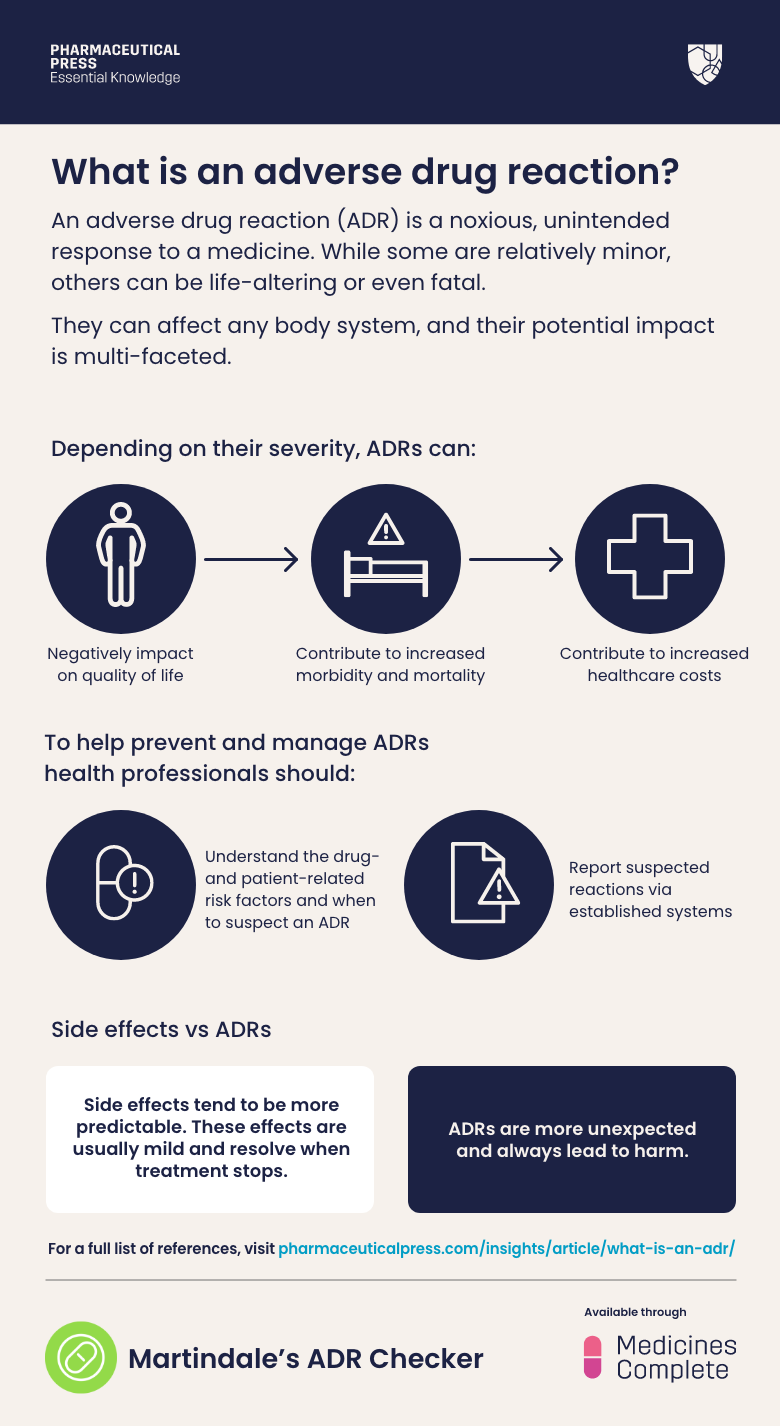
What is an adverse drug reaction?An adverse drug reaction (ADR) is a noxious, unintended response to a medicine.¹ While some are relatively minor, others can be life-altering or even fatal.²
An adverse drug reaction (ADR) is a noxious, unintended response to a medicine.¹ While some are relatively minor, others can be life-altering or even fatal.²
Please complete the form at the bottom of this article to request a complimentary trial of MedicinesComplete.
ADRs can affect any body system, and their potential impact is multi-faceted. Depending on their severity, ADRs can negatively impact on quality of life, and contribute to increased morbidity, mortality, and healthcare costs.² ³ By mimicking disease, they can also lead to unnecessary investigations, and result in delays to treatment.³
Yet many of these consequences are preventable.⁴ By understanding the most important risk factors, being vigilant for ADRs, as well as reporting suspected reactions via established systems, health professionals can help to avoid the avoidable – and keep patients safe.
While the terms ADR and side effect are often used interchangeably, there are differences between the two.⁶ Side effects tend to be more predictable; for example, many antibiotics can cause diarrhoea or nausea, but these effects are usually mild and resolve during treatment.
Some medicines can also be prescribed specifically to achieve a known side effect. The drug minoxidil, initially used to treat high blood pressure, was noted to cause unwanted hair growth and is now widely used as a treatment for hair loss.
ADRs, on the other hand, are typically unexpected and always lead to harm.⁵
Types of adverse drug reactions
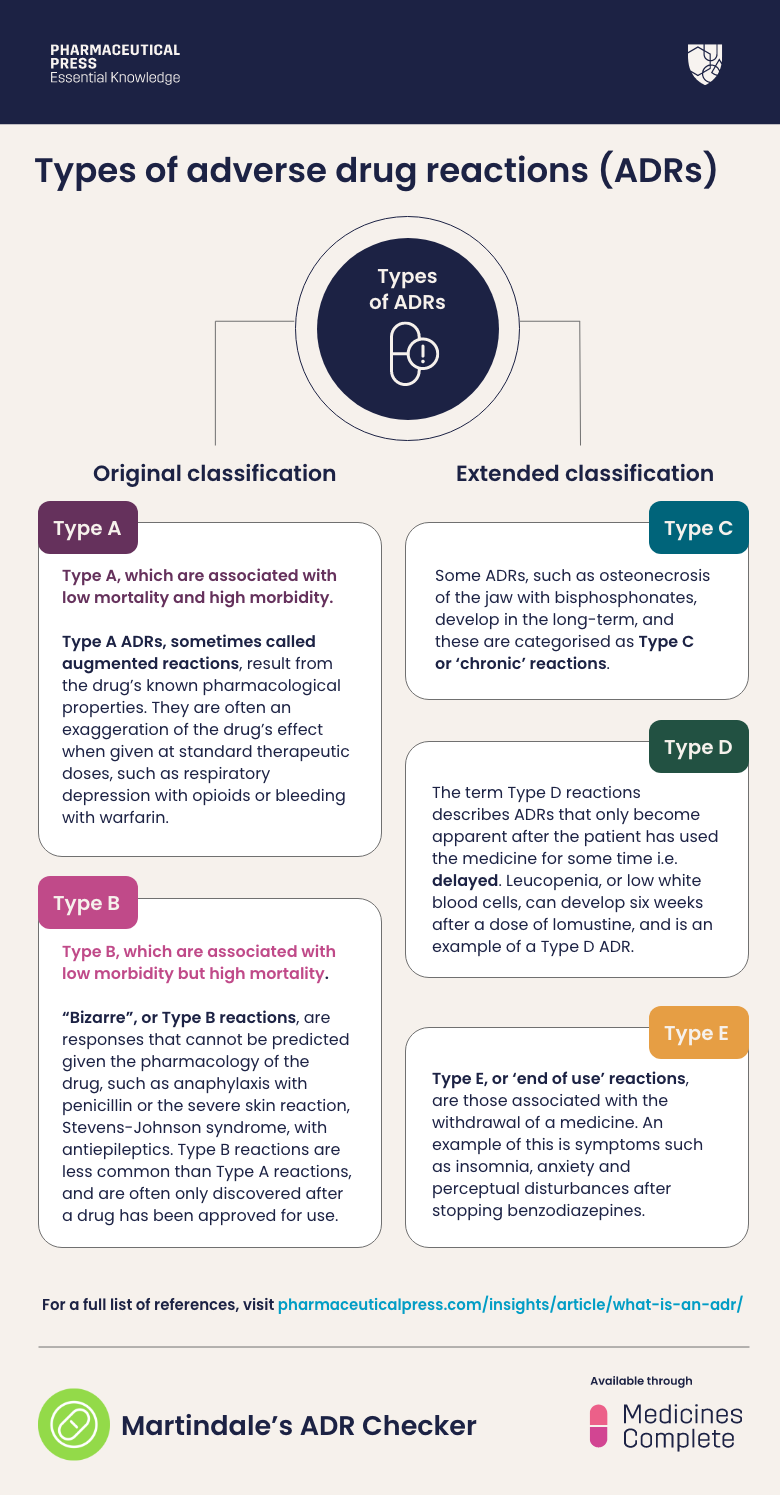
Traditionally, ADRs have been classified in two categories:³ ⁵
Type A, which are associated with low mortality and high morbidity, and Type B, which are associated with low morbidity but high mortality.⁵
Type A or ‘augmented’ reactions, are dose-dependent and predictable based on the known pharmacology of the drug. These reactions account for around 80% of all ADRs and are usually identified during clinical trials. Examples include respiratory depression with opioids or bleeding with warfarin.³
Type B or ‘bizarre’ reactions are not dose-related, tend to be idiosyncratic and not usually predictable from the pharmacology of the drug. Type B reactions often have an immunological or genetic basis, for example, many drugs can trigger complications in people with hereditary porphyria.⁵ Type B reactions are less common than Type A reactions and are often only identified after a drug has been approved for use.³
This basic classification does not easily encompass all ADRs, so over the years it has been extended to include a further three categories.³ ⁶
Type C or ‘chronic’ reactions occur after prolonged exposure to a drug and are usually related to cumulative dose. Examples include pulmonary fibrosis with amiodarone and osteonecrosis of the jaw with bisphosphonates.
Type D or ‘delayed’ reactions can occur a long time after a drug has been administered. The delay between use of the drug and the reaction can make it challenging to establish a link. Examples of type D reactions are leucopenia with lomustine and meningioma with medroxyprogesterone acetate.
Type E, or ‘end of use’ reactions, are associated with the withdrawal of a medicine. An example is symptoms such as insomnia, anxiety and perceptual disturbances after stopping benzodiazepines.³
DoTS
A further classification system called ‘DoTS’ was subsequently proposed.³ ⁵ Dose-relatedness, time course, and susceptibility are factors that can help to categorise ADRs:⁵ As well as the dose (Do), the time course (T), of the reaction, and factors influencing the susceptibility of the patient (S), such as age and renal function, also need to be taken into account. This classification tool, although more comprehensive, is not widely used in clinical practice.
How common are adverse drug reactions?
Under-diagnosis and under-reporting of ADRs has made it difficult to define their prevalence.² We know they are common, but their frequency varies across healthcare settings and populations.
Key studies on the epidemiology of ADRs have found:
- A 2021 systematic review and meta-analysis of studies carried out in primary care estimated an ADR prevalence of around 8%, with up to 38% of these reactions considered preventable.⁷
- A UK prospective study of hospital admissions due to ADRs in 2004 found a prevalence of 6.5% and suggested that the outcome was fatal in around 2% of these admissions.⁸
- A similar, more recent study found that an ADR was the primary or contributing cause of admission in 16.5% of hospital admissions over a one-month period.⁹ Of these, the majority were type A reactions and 40% were assessed as possibly avoidable. Drug-drug interactions were also frequently implicated.
- A meta-analysis of studies in adult in-patients found the pooled estimate of ADR prevalence to be 19%; about one third of these reactions were assessed as preventable.¹⁰
- An analysis of ADR reports to the World Health Organization (WHO) pharmacovigilance database between 2010 and 2019 found that just over 1% had a fatal outcome and many were in elderly people.¹¹
With information on ADRs for more than 1600 drugs used internationally, Martindale’s ADR Checker ensures quick decision-making at the point of care.
Risk factors
While some ADRs are unpredictable (e.g. an anaphylactic reaction to penicillin in a patient who has previously taken it without incident), there is good evidence that many are preventable.
Health professionals therefore need to understand the risk factors for an ADR in order to weigh up the risks versus benefits of a particular medicine in a specific patient. These include: age, polypharmacy, co-morbidities, pharmacogenomics, sex, ethnicity, potential for drug interactions, and pregnancy.
Certain ‘high-risk medicines’ have the potential to cause significant patient harm, even when used as intended, posing challenges for health professionals.¹² Antiplatelets, anticoagulants, antineoplastics, immunosuppressants, diuretics, antidiabetics, and antibiotics are among the drug classes consistently implicated in ADRs.
How much do adverse drug reactions cost?
As well as their high human cost, ADRs have significant economic impact, associated with hospital admissions, prolonged hospital stay, and additional unnecessary interventions.⁹ ¹³ In their study of drug-related hospital admissions, Osanlou et al estimated the direct one-month cost to the hospital at nearly £0.5M. Extrapolated nationally, the projected annual cost to the NHS in England was £2.21 billion. This does not take into account the wider costs, such as ADRs occurring in the community.
Assessing and managing adverse drug reactions
Health professionals should be aware of the most frequent ADRs caused by commonly prescribed medicines. The most common reactions are those affecting the central nervous system (e.g. dizziness, headache or drowsiness), the gastrointestinal tract (e.g. nausea, vomiting), skin (e.g. rashes), liver (e.g. abnormal liver function tests) or kidneys (e.g. acute kidney injury). Rare ADRs, such as drug-induced lupus, fixed drug eruptions, and drug-induced eosinophilia or angioedema, are particularly challenging to detect.⁴ ¹⁴
ADR management starts with accurate identification but this can be difficult as reactions can mimic almost any disease and affect all body systems.⁴ Health professionals need to be alert to the possibility of an ADR in the differential diagnosis of a wide range of conditions. The severity of reactions ranges from mild discomfort to life-threatening emergencies, which determines the urgency of treatment.
When an ADR is suspected, a thorough assessment can help to confirm or dismiss this suspicion. Conditions such as skin reactions, blood dyscrasias and serotonin syndrome strongly imply a drug-related event.⁵ The assessment should establish the indication for the drug, the dose taken, the timeline between when the drug was started and the onset of the reaction, and whether symptoms improved if the drug was stopped.
A comprehensive medication history, including over-the-counter and complementary medicines is essential. Other potential causes of the symptoms should be considered, including the patient’s underlying condition. Finally, the need for further investigations such as liver function tests or blood tests are required. In some cases, drug monitoring may be necessary. For example, checking serum concentrations of drugs such as digoxin and lithium in people who have experienced suspected signs of toxicity.¹⁵
The following questions for the patient can help establish a link between symptoms and a potential ADR:
- Have you taken the medicine before without any issue? While previous treatment without problems does not necessarily rule out an ADR, it may point against a drug cause.
- Did anything else change around the same time as the symptoms emerged? Were other treatments started, including over-the-counter medications, or is there anything to suggest disease progression? This can help pinpoint any alternative causes.
- Did the reaction occur only after you started the drug? If symptoms developed before the patient started taking the drug, an ADR can usually be ruled out.
- Did the reaction get better when you stopped taking the drug? If the effect resolved after the treatment was stopped, the possibility of an ADR increases.
- Did you, either intentionally or accidentally, use the drug again after the reaction? If so, what happened? If the symptoms occurred again on re-exposure to the drug, there is a greater likelihood of an ADR.
If it is likely that an ADR has occurred, management involves:¹⁴
- Stopping the suspected drug if the ADR is serious, or at the request of the individual, and avoiding its use in future.
- Considering alternative drug options if treatment is still required.
- Exploring dose reduction or a temporary stop to drug treatment if the benefit-to-harm balance is favourable e.g. Type A reactions may resolve with a reduction in dose.
- Considering the possibility of withdrawal effects if drug treatment is stopped suddenly.
Health professionals should also:
- Review and discuss the ADR with the person and colleagues, e.g. the prescriber, as appropriate.
- Explain the benefits and harms if another drug is prescribed to treat the ADR.
- Ensure the reaction is recorded in the patient’s health record.
- Consider submission of an ADR report (Yellow Card), if appropriate (see below).
Pharmacovigilance
Pharmacovigilance (PV) is the process of monitoring the effects of medicines after licensing in order to identify, quantify, and evaluate ADRs.¹⁶ ¹⁷
When medicines come onto the market, there is relatively limited information about their safety from clinical trials. Because these trials generally involve fairly small numbers of patients they will identify only the more common adverse effects. Furthermore, the strict conditions in clinical trials do not always reflect how medicines will be taken after launch, such as use by a wider age range of people, those taking other medicines, and who have varied lifestyles and/or complex co-morbidities. Rare or long latency adverse effects are identified only when large numbers of patients have taken a medicine over many years. Therefore, effective surveillance after marketing is essential for the identification of rare adverse effects and to ensure that appropriate action is taken.
Post-marketing drug safety surveillance (PMS) involves the continuous monitoring of medicines once they reach the market to detect, assess, and understand ADRs so that, where possible, they can be prevented. It starts as soon as a medicine is licensed and continues over the entire period it is available for patient use. PMS aims to identify safety signals, or information on a new or known ADR that may be caused by a drug and requires further investigation in larger populations. It is essential for protecting the safety of individual patients, and provides health professionals with a better understanding of a drug’s safety profile, thereby guiding informed prescribing.¹⁷
Reporting adverse drug reactions
In the UK, the MHRA monitors the safety of medicines using the Yellow Card Scheme.¹⁸ The scheme is vital in helping to ensure that all healthcare products are acceptably safe for patients and users. It relies on voluntary reporting of problems by health professionals and the public (including patients, parents, and caregivers). Reports can be made for reactions relating to vaccines, blood factors and immunoglobins, herbal and homeopathic medicines, medical devices, or defective (low quality) medicines, as well as fake or counterfeit medicines and e-cigarette products.
For established medicines and vaccines all serious suspected ADRs should be reported, even if the effect is well recognised.¹⁸
New medicines are intensively monitored to ensure that any new safety issues are identified promptly. The MHRA encourages the reporting of all suspected reactions to newer drugs and vaccines via the Black Triangle scheme.¹⁹ These products are denoted by an inverted Black Triangle symbol (▼) in the patient and prescribing information. The scheme covers newly marketed medicines, those with new indications, routes of administration or new delivery systems, and established medicines being used in a new patient population.³ ¹⁹
The MHRA uses Yellow Card reports and other data to assess the status of Black Triangle products after they have been on the market for five years, and the symbol is not removed until the drug’s safety is well established.¹⁹
The European Medicines Agency publishes a regularly updated list of Black Triangle medicines under additional monitoring.²⁰
In conclusion, ADRs are common, often avoidable, and a critical threat to patient safety and healthcare costs.²¹
The prevention of ADRs requires diligent prescribing practices, avoiding polypharmacy, and regular review and monitoring of medication use.
Health professionals should carefully evaluate patient risk factors such as age, co-morbidities, history of side effects and the potential for drug interactions before a medication is prescribed.
A multidisciplinary approach across the whole healthcare team is key to successful, sustainable medicines optimisation.²¹
Patients should be counselled about their medicines and know what to do if they experience potential ADRs.
In the UK, prompt reporting of appropriate suspected reactions via the Yellow Card Scheme is an essential step in safeguarding public health.
Trial form
Please complete the form below to request a complimentary trial to knowledge products through MedicinesComplete.
References
- European Medicines Agency. Glossary. Regulatory terms. Available at: [https://www.ema.europa.eu/en/glossary-terms/adverse-drug-reaction] (Accessed: 23 July 2026).
- Jutley GS, Pucci M, Ferner RE, et al. Adverse drug reactions and interactions, Medicine, 2024; 52 (1): 15-22.
- MHRA Guidance on adverse drug reactions. Available at: [https://assets.publishing.service.gov.uk/government/uploads/system/uploads/attachment_data/file/949130/Guidance_on_adverse_drug_reactions.pdf] (Accessed: 23 July 2026).
- Coleman JJ, Pontefract SK. Adverse drug reactions. Clin Med. 2016;16(5):481-485. doi:10.7861/clinmedicine.16-5-481.
- Evans J, Robinson M, Amare M. Adverse drug reactions. Anaesthesia & Intensive Care Medicine, 2025; 27: 54-59.
- IU Phar. (n.d.). Adverse drug reactions. Available at: [https://pharmacologyeducation.org/adverse-drug-reactions/] (Accessed: 23 July 2026).
- Insani WN, Whittlesea C, Alwafi H, et al. Prevalence of adverse drug reactions in the primary care setting: A systematic review and meta-analysis. PLoS ONE. 2021;16(5):e0252161. doi:10.1371/journal.pone.0252161.
- Pirmohamed M, James S, et al. Adverse drug reactions as cause of admission to hospital: prospective analysis of 18 820 patients. BMJ 2004; 329(7456): 15-19.
- Osanlou R, Walker L, et al. Adverse drug reactions, multimorbidity and polypharmacy: a prospective analysis of 1 month of medical admissions. BMJ Open, 2022: 12(7), e055551.
- Laatikainen O, Miettunen J, Sneck S, et al. The prevalence of medication-related adverse events in inpatients-a systematic review and meta-analysis. European Journal of Clinical Pharmacology 2017: 73(12): 1539-1549.
- Montastruc JL, Lafaurie M, de Canecaude C, et al. Fatal adverse drug reactions: A worldwide perspective in the World Health Organization pharmacovigilance database. Br J Clin Pharmacol.2021;87(11):4334-4340. doi:10.1111/bcp.14851.
- Coon R. High-risk medications: a guide for pharmacy professionals. Pharmaceutical Journal. 05 September 2025. Available at: [https://pharmaceutical-journal.com/article/ld/high-risk-medications-a-guide-for-pharmacy-professionals](Accessed: 24 July 2026).
- Formica D, Sultana J, et al. The economic burden of preventable adverse drug reactions: a systematic review of observational studies. Expert opinion on drug safety, 2018: 17(7): 681-695.
- Adverse drug reactions (2022). Available at: [https://cks.nice.org.uk/topics/adverse-drug-reactions] (Accessed: 24 July 2026).
- NICE, Scenario: Adverse drug reactions (2022). Available at: [https://cks.nice.org.uk/topics/adverse-drug-reactions/management/adverse-drug-reactions/] (Accessed: 24 July 2026).
- Pharmacovigilance. Available at: [https://www.who.int/teams/regulation-prequalification/regulation-and-safety/pharmacovigilance] (Accessed: 25 July 2026).
- Alomar M, Tawfiq AM, et al. Post marketing surveillance of suspected adverse drug reactions through spontaneous reporting: current status, challenges and the future. Therapeutic advances in drug safety, 2020; 11 2042098620938595.
- The Yellow Card scheme: guidance for healthcare professionals, patients and the public. Available at: [https://www.gov.uk/guidance/the-yellow-card-scheme-guidance-for-healthcare-professionals-patients-and-the-public#what-to-report] (Accessed: 25 July 2026).
- UK Government. (2014). The Black Triangle scheme. Available at: [https://www.gov.uk/drug-safety-update/the-black-triangle-scheme-or] (Accessed: 25 July 2026).
- European Medicines Agency. (n.d.) Medicines under additional monitoring. Available at: [https://www.ema.europa.eu/en/human-regulatory-overview/post-authorisation/pharmacovigilance-post-authorisation/medicines-under-additional-monitoring] (Accessed: 25 July 2026).
- Walker LE & Pirmohamed M (2023). Increasing trend in hospitalisation due to adverse drug reactions: can we stem the tide?. Drug & Therapeutics Bulletin; 61(6): 87-91. https://dx.doi.org/10.1136/dtb.2022.000050