



Adverse effects of atypical antipsychotics
In recent years, second-generation (or atypical) antipsychotics have become widely used in managing mental health conditions. While they have fewer extrapyramidal side effects (EPS) than their predecessors (i.e. first-generation or typical antipsychotics), they are still associated with important adverse effects (AEs).¹ ²
In this article, we will explain the differences between first- and second-generation antipsychotic medication and outline the potential AEs of atypical antipsychotics. We will also look at the importance of individualised treatment selection and monitoring for side effects.
Please complete the form at the bottom of this article to request a complimentary trial of MedicinesComplete.
What are antipsychotics?
Health professionals use antipsychotic medicines, also sometimes known as neuroleptics, to treat and manage symptoms of a range of psychiatric disorders.¹ ²
Indications include acute psychoses, schizophrenia, mood (or affective) disorders, including depression and bipolar disorder, delirium and acute agitation.¹ ² The medications have sedative, anxiolytic, antimanic, mood stabilising, and antidepressant properties.
First-generation versus second-generation antipsychotics
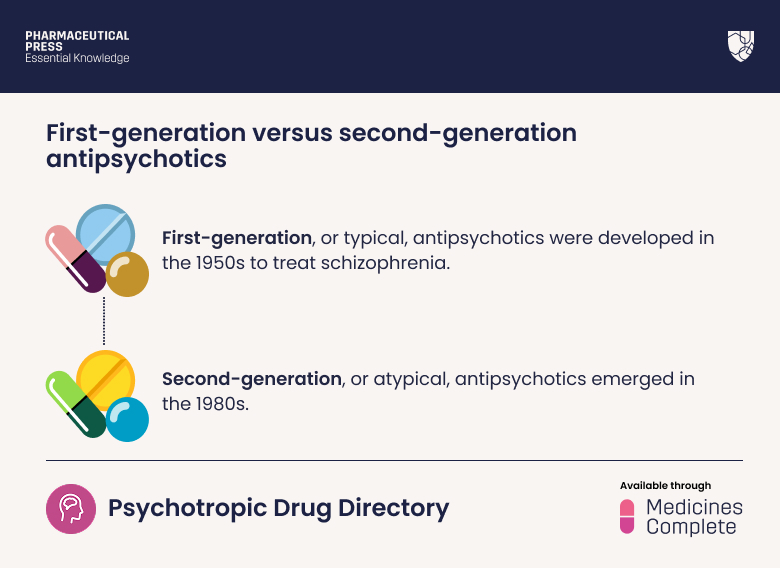
First-generation, or typical, antipsychotics were developed in the 1950s to treat schizophrenia. Studies later proved them to be effective in other conditions, such as acute mania, agitation, and bipolar disorder.²
This class of antipsychotic includes phenothiazine derivatives (e.g. chlorpromazine), butyrophenones (e.g. haloperidol), thioxanthenes (e.g. flupentixol), diphenylbutylpiperidines (e.g. pimozide), and substituted benzamides (e.g. sulpiride).³
They work primarily by blocking the dopamine type 2 receptors in the brain.³ However, this mechanism of action is linked with a number of EPS, or movement disorders, including tremor, parkinsonism, akathisia, and dystonia. Some EPS, notably tardive dyskinesia, develop after long-term exposure to the medicines. EPS can cause significant distress for patients and are associated with treatment non-adherence.⁴
Second-generation, or atypical, antipsychotics emerged in the 1980s. They act on other receptor types, such as serotonin (5-HT2A), with the mechanism of action differing from drug to drug.¹ Relative liability for inducing EPS was the reason for the initial “typical/atypical” classification although only clozapine, and possibly quetiapine, are completely atypical, as they have a very low or zero likelihood of causing EPS.
All antipsychotics introduced since 1990 are classified as second-generation, or atypical, antipsychotic drugs.¹ ⁴ Examples include amisulpride, aripiprazole, asenapine, cariprazine, clozapine, lurasidone, olanzapine, paliperidone, quetiapine, and risperidone.³
Antipsychotics differ in their pharmacology, pharmacokinetics, effectiveness and tolerability. Response and tolerability also differ from patient to patient. Other than clozapine, which is superior to other antipsychotics in treatment-resistant schizophrenia, there is little difference in efficacy between the drugs.¹ ⁵ ⁶ Consequently, there is no first-line antipsychotic drug that is suitable for all patients.¹ ³
The choice of agent, then, should be tailored to the individual. Health professionals should take into account each person’s specific risk factors alongside the potential side effects of the treatment options and discuss these with the patient and/or carer.
Psychotropic Drug Directory supports the optimal and rational use of mental health medications, to improve the quality of life for people with mental health needs.
Potential adverse effects of second-generation antipsychotics
All classes of antipsychotic drug have the main types of adverse effects in common and these contribute significantly to non-adherence and treatment discontinuation. These include weight gain, dyslipidaemia, increases in plasma glucose/diabetes, and EPS including neuroleptic malignant syndrome. The risk of these adverse effects varies by drug and drug class.³
Second-generation antipsychotic drugs are generally associated with a lower risk of EPS, most likely due to their actions at receptor sites other than dopamine and therapeutic efficacy can usually be achieved at doses that do not cause EPS.⁴ They are also less likely to cause hyperprolactinaemia.³ These agents do, nevertheless, have wide-ranging and important potential side effects that vary according to the particular agent and its mechanism of action.³ ⁴ ⁵
Download our Psychotropic Drug Directory user guide.
The most common potential side effects are discussed below:
Metabolic side effects
Second-generation antipsychotics are associated with a range of metabolic side effects, including significant weight gain, dyslipidaemia, and hyperglycaemia.⁵ ⁷ The propensity to cause weight gain varies by drug and the risk is greater in younger patients, females, and those with lower body mass index.⁸ While the increase occurs mainly in the first six months of treatment, it can continue more slowly after this time.⁹
Often, weight gain is compounded by other risk factors that are more common in people with mental ill health than the rest of the population. Physical inactivity, an unhealthy diet, smoking, alcohol, other medications, and the impact of symptoms can all contribute to weight gain.⁷ ¹⁰
The term ‘metabolic syndrome’ may be used when a patient develops hypertension, hyperglycaemia, and hypertriglyceridemia, which may contribute to coronary heart disease and type 2 diabetes.⁷ ¹¹ It is also worth noting that significant weight gain can contribute to poor medication adherence.¹²
Not all second-generation antipsychotics have the same impact on the metabolic system. Olanzapine and clozapine are associated with the highest risk of weight gain in clinical practice, whilst amisulpride, asenapine, aripiprazole, cariprazine, and lurasidone are less likely to have an impact.³ ¹⁰
When weight gain is a persistent problem, it may be necessary to switch to a drug with a lower risk of weight gain. The risks of switching include the new medication causing side effects and being less effective for that person, leading to a relapse of their psychiatric disorder.¹⁰
There is also some experience of prescribing adjunctive aripiprazole (in patients taking clozapine or olanzapine) or metformin to help mitigate weight gain but there is a lack of clear consensus on their appropriate use.¹⁰
Cardiovascular effects
Importantly, long-term exposure to antipsychotics of either generation may cause cardiac damage. This may result in myocarditis or dilated cardiomyopathy, or lead to ventricular hypertrophy, ischemic heart disease, or pulmonary thromboembolism.¹³ ¹⁴ The medicines have also been associated with an increase in the risk of sudden cardiac death.¹³ ¹⁴
Metabolic syndrome, as discussed above, increases the risk of atherosclerotic cardiovascular disease, including hypertension, coronary heart disease, stroke, and premature death.¹³
Second-generation antipsychotic drugs are also associated with cardiovascular side effects such as tachycardia, arrhythmias, heart failure, and hypotension.¹³ ¹⁴ Postural hypotension is common, usually presenting during initial dose titration, although it can become chronic, possibly leading to syncope and falls-related injuries. Clozapine and quetiapine are the second-generation agents most likely to cause postural hypotension.³ Slow dose titration is commonly used to minimise this side effect.
The ECG abnormality QT interval prolongation has been reported with both generations of antipsychotics (and is a particular concern with haloperidol, pimozide and quetiapine).³ ¹⁵ ¹⁶ This is a risk factor for developing Torsades de Pointes (TdP), a potentially life-threatening cardiac arrhythmia, and sudden cardiac-related death.³ Psychotropic Drug Directory categorises antipsychotic medicines according to their risk of QT prolongation as no effect, mild, moderate and severe.¹⁶ Drugs with a low to moderate tendency to prolong the QT interval include aripiprazole, amisulpride, cariprazine and olanzapine.
Movement disorders
As mentioned above, EPS are less common with second-generation antipsychotics, but they can still occur.¹ ³ ⁴
Parkinsonian symptoms, such as bradykinesia and tremor, may appear gradually. They are more common in elderly females or those with pre-existing neurological damage such as stroke.³ ⁴ Dystonia, or uncontrolled muscle spasm in any part of the body, occurs more commonly in young males.² Acute dystonia can develop within hours of starting treatment. Akathisia, or restlessness, characteristically occurs within hours or weeks of either starting treatment, or of dose escalation.⁴ ⁵
Tardive dyskinesia is the most serious potential EPS, and it occurs more commonly in elderly females. The abnormal involuntary movements of the lips, tongue, face, and jaw can develop on long-term or high-dose therapy, or even after treatment discontinuation. In some patients, it is irreversible.⁵
Of the second-generation antipsychotics clozapine, olanzapine, quetiapine, and aripiprazole have a lower risk of EPS.³
Other side effects
Other potential side effects of second-generation antipsychotics include:
Hyperprolactinaemia
Antipsychotic drugs act on dopamine, which inhibits prolactin release, so most can increase prolactin concentration. Sexual dysfunction, reduced bone mineral density, menstrual disturbances, breast enlargement, and galactorrhoea are clinical symptoms of hyperprolactinaemia. It may also increase the risk of breast cancer.³
First-generation antipsychotics are the most likely to cause hyperprolactinaemia, particularly haloperidol.³ It occurs very rarely with: aripiprazole, asenapine, cariprazine, clozapine, and quetiapine.³
Sexual dysfunction
Sexual dysfunction is a common side effect of all antipsychotic medication. It can be compounded by physical or mental illness, and by substance misuse.⁵
Risperidone and olanzapine are most likely to cause sexual dysfunction, while aripiprazole and quetiapine are among the least likely.³ ¹⁷
Neuroleptic malignant syndrome
Neuroleptic malignant syndrome is a rare but potentially fatal side effect of all antipsychotic drugs.³
Signs include hyperthermia, fluctuating levels of consciousness, muscle rigidity, and autonomic dysfunction with fever, tachycardia, labile blood pressure, and sweating.³ Antipsychotic drugs should be discontinued if neuroleptic malignant syndrome is suspected.
Read our article on common mental health medications.
Blood dyscrasias
Clozapine is a known cause of the serious blood dyscrasia, agranulocytosis.¹⁷ Following fatalities, the MHRA recommends monitoring clozapine blood concentrations in certain clinical situations such as when:
- a patient stops smoking or switches to an e-cigarette
- concomitant medicines might interact to increase blood clozapine levels
- a patient has pneumonia or other serious infection
- reduced clozapine metabolism or toxicity is suspected.
Importance of monitoring
Second-generation antipsychotics have transformed the management of psychiatric disorders, offering effective symptom relief with a reduced risk of EPS compared to first-generation drugs. Their use, however, is associated with significant AEs that make careful treatment selection and monitoring essential.
Regular monitoring allows health professionals to detect the early signs of side effects. They may use the findings to adjust dosages or switch treatment, recommend lifestyle changes, or initiate preventive measures to mitigate health risks. Specialist advice may be needed.
Regular assessment of weight, glucose levels, lipid profiles, cardiovascular health, as well as ongoing discussion with the patient about symptoms can help health professionals detect the early signs of AEs and take action when necessary.
Health professionals can also use Drug Monitoring Checker, an essential tool to support them make effective drug monitoring decisions at the point of care.
Through vigilant monitoring and individualised therapy, health professionals can balance the risks and benefits of treatment to ensure better outcomes for their patients.
Trial form
Please complete the form below to request a complimentary trial to knowledge products through MedicinesComplete.
References
- Taylor, D.M., Barnes, T.R.E. and Young, A.H. (2025). Schizophrenia and Related Psychoses. In The Maudsley Prescribing Guidelines in Psychiatry (eds D.M. Taylor, T.R.E. Barnes and A.H. Young). Available at: https://doi-org.knowledge.idm.oclc.org/10.1002/9781119870203.mpg001.pub2 Last accessed: 08 September 2026.
- Abou-Setta, A. M., Mousavi, S. S., et al. (2012). First-generation versus second-generation antipsychotics in adults: Comparative effectiveness. [Internet]. Rockville (MD): Agency for Healthcare Research and Quality (US). Available at: https://www.ncbi.nlm.nih.gov/books/NBK107237/ Last accessed: 08 September 2026.
- BNF, Psychoses and related disorders. Available at: Joint Formulary Committee. British National Formulary (online) London: BMJ and Pharmaceutical Press <http://www.medicinescomplete.com> Last accessed: 10 September 2026.
- D’Souza RS, Aslam SP, Hooten WM. Extrapyramidal Side Effects. [Updated 2025 Jan 19]. In: StatPearls [Internet]. Treasure Island (FL): StatPearls Publishing; 2025 Jan-. Available at: https://www.ncbi.nlm.nih.gov/books/NBK534115/ Last accessed: 10 September 2026.
- Willner K, Vasan S, et al. Atypical antipsychotic agents. In: StatPearls [Internet] 2024 May 1. StatPearls Publishing Treasure Island, FL. Available at: https://www.ncbi.nlm.nih.gov/books/NBK448156/ Last accessed: 10 September 2026.
- Gammon, D., Cheng, C., et al. (2021). Clozapine: why is it so uniquely effective in the treatment of a range of neuropsychiatric disorders? Biomolecules, 11(7), 1030.
- Carli, M., Kolachalam, S., et al. (2021). Atypical antipsychotics and metabolic syndrome: from molecular mechanisms to clinical differences. Pharmaceuticals, 14(3), 238.
- Musil, R., Obermeier, M., et al. (2015). Weight gain and antipsychotics: a drug safety review. Expert Opinion on Drug Safety, 14(1), 73–96. Available at: https://doi-org.knowledge.idm.oclc.org/10.1517/14740338.2015.974549 Last accessed: 10 September 2026.
- Haddad, P. (2017). Antipsychotic medication and weight gain. Available at: https://www.bap.org.uk/articles/antipsychotic-medication-and-weight-gain/ Last accessed: 09 September 2026.
- Cooper SJ., Reynolds GP., et al. (2016) BAP guidelines on the management of weight gain, metabolic disturbances and cardiovascular risk associated with psychosis and antipsychotic drug treatment. Journal of Psychopharmacology. 30(8):717-748. doi:10.1177/0269881116645254 Last accessed: 13 September 2026.
- Akinola PS, Tardif I, Leclerc J. Antipsychotic-Induced Metabolic Syndrome: A Review. Metab Syndr Relat Disord. 2023 Aug;21(6):294-305. doi: 10.1089/met.2023.0003. Epub 2023 Jun 22. PMID: 37347965.
- Dayabandara, M., Hanwella, R., et al. (2017). Antipsychotic-associated weight gain: management strategies and impact on treatment adherence. Neuropsychiatric disease and treatment, 2231-2241.
- Li, X. Q., Tang, X., et al. (2021). Antipsychotics cardiotoxicity: what’s known and what’s next. World Journal of Psychiatry, 11(10), 736.
- DeJongh BM. Clinical pearls for the monitoring and treatment of antipsychotic induced metabolic syndrome. Ment Health Clin [Internet]. 2021;11(6):311-9. DOI: 10.9740/mhc.2021.11.311.
- NHS Specialist Pharmacy Service. Commonly used medicines associated with QT interval prolongation. Published 24 August 2026 · Last updated 27 August 2026 Last accessed: 10 September 2026.
- Chapter 3.2 Risk of psychotropic drugs in cardiovascular disease. Psychotropic Drug Directory MedicinesComplete — CONTENT > Psychotropic Drug Directory > Problem areas: 3.2 Cardiovascular (CV) disease Last accessed: 13 September 2026.
- Clozapine and other antipsychotics: monitoring blood concentrations for toxicity. Available at: https://www.gov.uk/drug-safety-update/clozapine-and-other-antipsychotics-monitoring-blood-concentrations-for-toxicity Last accessed: 13 September 2026.