






How to use drug monographs to safely prescribe drugs in combination
This article describes how to best use British National Formulary (BNF) and BNF for Children (BNFC) drug monograph information to support safe prescribing, particularly when drugs are used in combination.
BNF and BNFC drug monographs are designed to be considered in their entirety. When a combination of drugs is prescribed, each drug monograph should be consulted, and the information should be used collectively when making prescribing decisions for a patient.
Drug monographs contain information such as indications and dose, contra-indications, cautions, interactions, and side-effects that helps determine whether a drug is safe and appropriate for use.
Please complete the form at the bottom of this article to request a complimentary trial of MedicinesComplete.
Confirming indication and selecting an appropriate dose
The Indications and dose section provides recommendations around which doses and corresponding routes should be used for the respective indications. For drugs that require a dose adjustment when used concurrently with another drug, for example simvastatin with amiodarone, recommendations are described at the end of the Indications and dose section, under ‘Dose adjustments due to interactions’.
Indications and doses are separated under the preparation name if there are differences between the formulations or brands of a drug, for example the branded preparations of semaglutide.
Evaluating the risk of drug interactions
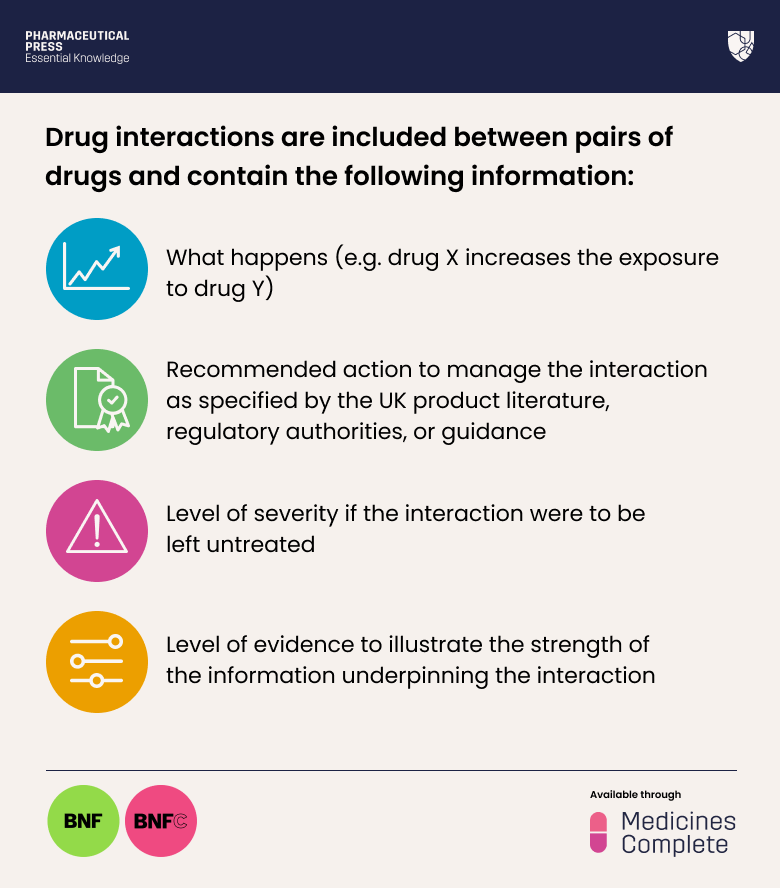
BNF and BNFC include information on clinically important drug interactions, with the main focus being pharmacokinetic drug interactions. Pharmacokinetic interactions occur when one drug affects the absorption, distribution, metabolism or excretion of another, influencing the amount of drug available and subsequently its pharmacological effect. Drug interactions are included between pairs of drugs and contain the following information:
- What happens (e.g. drug X increases the exposure to drug Y)
- Recommended action to manage the interaction as specified by the UK product literature, regulatory authorities, or guidance
- Level of severity if the interaction were to be left untreated
- Level of evidence to illustrate the strength of the information underpinning the interaction.
BNF and BNFC interactions content also includes information on some pharmacodynamic effects to draw users’ attention to the theoretical risks of the concurrent use of two or more drugs with the potential for the same additive effect. For example, hypotension or nephrotoxicity. However, the content is not exhaustive as it is not feasible to include messages for every instance where two drugs have similar side-effects. Where pharmacodynamic effects are included in the interactions content, these are assessed against set inclusion criteria. These pharmacodynamic interactions are theoretical; the data does not come directly from investigating the interaction but is a logical result based on the known pharmacology of the drugs.
If a drug in BNF or BNFC has drug interactions, this will be indicated in the Interactions section of the drug monograph. In the BNF + BNFC App and online there is a clickable link to the full list of interactions. For combination drugs, there are separate links to the interactions of each constituent. In print editions there are cross references to ‘Appendix 1’ where the interactions are listed alphabetically by drug and/or drug class. However, the easiest way to find drug interactions is by using the interactions checkers in the BNF + BNFC App and on MedicinesComplete, that allow users to search for all the interactions of one drug or for interactions between two or more drugs.
Some drugs have supplementary information that is displayed at the top of the list of interactions for the drug when viewing via the drug monograph or in ‘Appendix 1’ in print. These can include information about interactions with food or smoking, separation of administration, or route-specific information.
As BNF and BNFC are not specialist drug interaction resources, they do not include all drug-drug interactions. Only clinically important interactions are included. The ‘Frequently asked questions-clinical’ section in the BNF + BNFC App and online give more information regarding the interaction inclusion and exclusion criteria.
BNF and BNFC interactions content is not designed to be viewed in isolation. All the relevant information within a drug monograph, or drug monographs if a combination of drugs are used, should be consulted alongside their drug interactions when making prescribing decisions for an individual patient.
Managing cautions and contra-indications in prescribing decisions
The Cautions section highlights clinical situations where a drug may be prescribed, but only after careful consideration of the increased risk. Examples of these include situations where patient characteristics or co-prescribed drugs can amplify the risk. Cautions rarely occur in isolation. When several cautions apply across multiple drugs, the cumulative risk may be clinically significant, and this should be assessed on an individual patient basis, with the application of clinical judgement where necessary.
For example, the paroxetine monograph advises caution in elderly patients with current or recent significant hyponatraemia, as it may worsen the condition. This should be reviewed alongside information in monographs for other prescribed drugs, as co-prescribed drugs that also increase the risk of hyponatraemia may increase the cumulative risk.
The Contra-indications section highlights situations where a drug should not be used due to the risk of harm. In polypharmacy, these risks may be compounded. For example, clozapine is contra-indicated in bone-marrow disorders and carbimazole can cause bone-marrow disorders as a side-effect; if used together, the risk of harm is increased.
Recognising cumulative adverse effects
Drug side-effects are listed within the monograph separated by frequency, and within each frequency they are listed in alphabetical order. When additional information or management advice about a particular side-effect is required, this is displayed under ‘Side-effects, further information’.
When several drugs within a class share the same side-effects, these are presented together as class side-effects. These, together with the side-effects listed for individual drugs, should be considered together to understand the full side-effects profile. Class-level ‘Side-effects, further information’ may also be present if it applies to all the drugs within the class.
When multiple drugs are prescribed, the side-effects of each drug should be considered together, as two or more drugs with the same or similar side-effects could lead to an additive effect. This additive effect can be related to similar mechanisms of actions of drugs, such as with anticholinergic drugs like tricyclic antidepressants, drugs used for overactive bladder and antihistamines.
Reviewing important safety information
The Important safety information section includes warnings issued by regulatory bodies such as the Medicines and Healthcare products Regulatory Agency (MHRA). When several drugs are prescribed together, overlapping warnings or monitoring requirements could lead to an increased risk of harm, so safety considerations in this section should be assessed collectively.
Conclusion
BNF and BNFC drug monographs provide essential information to support clinical decision making in safe and effective prescribing — including indications and doses, cautions and contraindications, interactions, and side-effects. This whole-picture view is particularly important when drugs are used in combination and harm can potentially arise from cumulative or additive effects. It’s important to consider all sections of each drug monograph in an integrated way to ensure prescribing decisions are clear, safe, and robust.