



What is alert fatigue in healthcare?
Medication-related problems are one of the leading causes of patient harm worldwide and many approaches have been introduced to help minimise their occurrence.¹ ² Electronic systems are now used routinely to manage patient data and inform clinical decision-making, and these are designed to include alerts and clinical reminders (CRs) at the point of care.² ³
There are many different types of CR, not all of them relating to medicines. These include warnings, alerts, or prompts to remind health professionals about risks or the need to perform specific tasks or checks. For example, they may warn about drug allergy or drug interactions.
Some systems will use patient-specific information in the electronic health record (EHR) to ensure medication use in a patient is appropriate, e.g. in the context of clinical guidelines or drug-laboratory test checks.
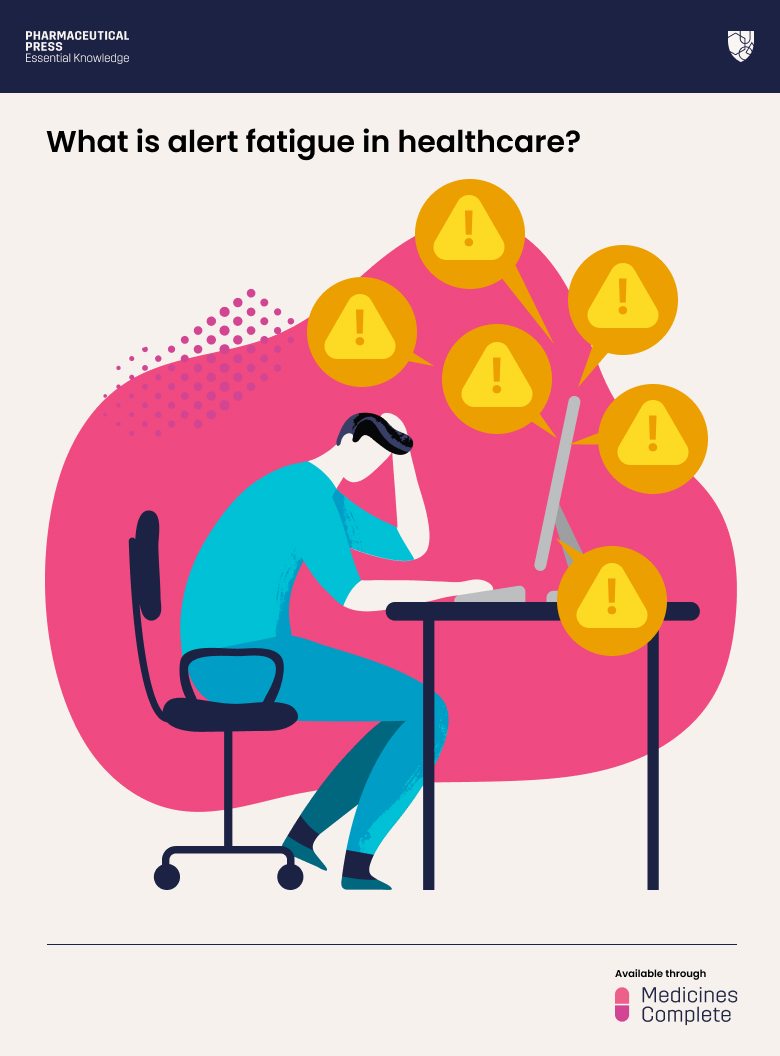
A key persistent issue with clinical decision support (CDS) systems is alert fatigue, where clinically important alerts are ignored alongside alerts that are not clinically important or relevant. If clinicians are presented with too many warnings, they may become desensitised and start to ignore them. In some situations an alert may justifiably be considered irrelevant, but if it is wrongly ignored this can lead to patient harm.
In this article we discuss alert fatigue, how it happens, why it matters, and ways to reduce it so that these vital alerts can have their intended effect in improving patient care.
Please complete the form at the bottom of this article to request a complimentary trial of MedicinesComplete.
Why alert fatigue matters for medicines
Medication errors are preventable events that lead to inappropriate medication use or patient harm.¹
The World Health Organisation (WHO) states that almost 50% of preventable patient harm is due to inappropriate use of medicines and other treatments.¹
There are an estimated 237 million medication errors each year in England alone, about 28% of which are potentially significant.⁴
New technologies present opportunities to make systems safer. Examples include EHR and e-prescribing systems.¹ ² ³ These systems can incorporate alerts, or nudges, to flag potentially important issues such as drug-drug interactions, patient allergies, contra-indications, or off-label uses, at the point of care.² ³ ⁵ ⁶
These often take the form of pop-up boxes on a computer screen with action points or warnings. There is good evidence that these safety alerts can ensure optimum drug dosing and reduce adverse drug events, thereby reducing hospital admissions, patient mortality, and healthcare costs.¹ ² ³ ⁵ ⁶
The term alert fatigue is derived from the similar phenomenon of alarm fatigue. This is a well-recognised problem in sectors such as aviation, nuclear power, and emergency care, where alarms often sound so frequently that workers no longer hear or respond to them.¹⁰
Alert fatigue occurs when health professionals become desensitised to alerts and warnings and then habitually override or ignore them.² ³ ¹¹
CDS systems usually have a facility whereby alerts can be dismissed, termed an override. If there are excessive or poorly targeted digital alerts, individuals can become overwhelmed and are less likely to notice, trust, or act upon them.
A US analysis of 279,476 prescriptions that invoked an alert found that the CR was likely to have prevented 402 adverse drug effects, of which 125 were potentially significant and 49 potentially serious.⁵
It was noted that accepting all alerts would likely have prevented three deaths and 45 disabilities. Research by Van der Sijs and colleagues suggested that as many as 300 nudges were needed to avoid a single adverse event, described as a poor signal-to-noise ratio.¹²
Another study found that only 28 of 382 (7.3%) alerts generated in an emergency department over a 10-month period were clinically appropriate. The override rate was over 90% and the health professional’s response was deemed appropriate in most cases.¹³
A recent systematic review acknowledged that CRs can support diagnosis, prescribing, and management of long-term conditions and improve safe, high-quality care.³ These alerts are, however, not always beneficial. They can only work if they are acted upon and the evidence suggests that is not always the case. Low-value or false-positive alerts can be justifiably ignored but if important safety alerts are not acted upon this increases the risk of preventable harm.
How common is alert fatigue and what causes it?
There is some research on how common alert fatigue is; the frequency of alert overrides allows us to gain some insight into the problem. A review of seventeen publications on overriding safety alerts in electronic prescribing systems suggested that 49% to 96% of safety alerts are overridden.¹² The authors emphasised that a high proportion of these may have been justifiable, but identified numerous issues with alerting systems.
These include: poor signal-to-noise ratio because the alert was not serious; the alert was irrelevant, difficult to interpret, or shown repeatedly; the clinician’s faith in their own knowledge or belief that the treatment was too important to change; lack of time and unnecessary workflow interruptions.
A study of more than 611,000 allergy alerts at two US hospitals found that override rates increased to around 88% over a 10-year period.¹⁴ The main reason given for the override action was that the alert was felt to be irrelevant, for example, the patient had tolerated the relevant medication in the past. Repeated alerts were also more likely to be overridden than first time alerts. Of concern, alerts warning of serious reactions with a strong clinical basis were overridden up to 74% of the time.
The causes of alert fatigue are not well studied but seem to be multifaceted and often overlap. The value of alerts is influenced by usability, perceived usefulness, relevance, and efficiency.²
Repeated exposure to the same warning, a perception that the alert is irrelevant or of low-value, and the sheer volume of reminders can all lead to desensitisation. Disruption to workflow is another important factor; disruptive alerts are among those most frequently overridden.³ ¹¹
A 2025 systemic review by Gani and colleagues analysed nine studies of alert fatigue in primary care.³ It explored GPs’ attitudes and experiences of CRs and set out to better understand factors such as the design of CRs, how they were used and factors contributing to alert fatigue.
Alert usefulness was found to depend heavily on their frequency, how clearly and accurately they were presented, and whether the IT systems supporting them were fast and reliable. Concerns were noted about the accuracy of alerts, and GPs felt that relying on them too heavily could undermine the value of their experience and understanding of individual patients.
Four studies reported that the high volume of alerts meant that they could not be processed in a timely manner. The technology underpinning the alert systems was also noted as a concern; seven studies described issues around the content and design of the alerts.
Towards potential solutions
Research on mitigating alert fatigue and optimising the use of CRs remains limited. It is clear, however, that there are concerns around the design, content accuracy, and “lack of contextual nuance” of CRs in CDS.³ ¹¹
Efforts are underway to reduce the quantity and improve the quality of alerts, though as yet there is no consensus on how to do so.
A 2015 study examining the factors associated with alerts concluded that alerts should be targeted to the sickest patients, physicians with the least amount of experience, and for the medicines with the greatest potential to cause harm.¹⁶ Hussain and colleagues explored how alert fatigue may be reduced using more interactive system designs and clinical role tailoring.¹¹
They noted that prescribers were more likely to accept CDS prompts tailored to their areas of clinical expertise.
Human factors such as how the user engages with the computer may also be important. These strategies have been incorporated into CDS, with promising results. For example, tiered alarms, indicating the likelihood or severity of an adverse event have been used successfully.
Another example builds on experience from the aviation industry; alarms are developed to seem patient or polite to avoid distracting pilots when they are busy. Such CRs may be accepted more often than impatient alarms. Researchers have also implemented alerts that avoid requiring attention at a particular time with some success.
Gani et al made recommendations for CRs, including: using clearer, more purposeful graphics; making the content more nuanced and tailored to each patient; giving clinicians more control over when and whether reminders appear; and involving the workforce earlier and more consistently in designing and developing alerts to ensure relevance.³
Conclusion
Alert fatigue has become an important and growing challenge in modern healthcare.
Research into the problem of alert fatigue indicates that the problem is not simply the number of alerts, but also how well they are applied to real-life clinical practice. The clarity, accuracy, timing of CRs and the reliability of the systems that deliver them all play a role.
We also know that health professionals want reminders that support, rather than replace, their professional judgment.
Healthcare teams need to be able to judge the potential relevance and validity of CRs in their own environment. Improving alert design, tailoring content to individual specialties and patients, and involving frontline staff early in development could all help to tackle alert fatigue and ensure that clinical reminders enhance patient safety.
Trial form
Please complete the form below to request a complimentary trial to knowledge products through MedicinesComplete.
References
1. WHO. (2023). Medication without harm. Available at: https://iris.who.int/server/api/core/bitstreams/1eacccb6-838e-4787-bfd9-4bdeb4debfcf/content Last accessed: 27th November 2025.
2. Tolley C and Husband AK. More alerts, less harm? Rethinking medication safety with AI | BMJ Quality & Safety Last accessed: 18th December 2025.
3. Gani, I., Litchfield, I., et al. (2025). Understanding “alert fatigue” in primary care: Qualitative systematic review of general practitioners attitudes and experiences of clinical alerts, prompts, and reminders. Journal of medical Internet research, 27, e62763.
4. Elliott, R. A., Camacho, E., et al. (2021). Economic analysis of the prevalence and clinical and economic burden of medication error in England. BMJ Quality & Safety, 30(2), 96-105.
5. Weingart, S. N., Simchowitz, B., et al. (2009). An empirical model to estimate the potential impact of medication safety alerts on patient safety, health care utilization, and cost in ambulatory care. Archives of internal medicine, 169(16), 1465-1473.
6. Kaushal, R., Shojania, K. G., et al. (2003). Effects of computerized physician order entry and clinical decision support systems on medication safety: a systematic review. Archives of internal medicine, 163(12), 1409-1416.
7. Walton, R., Dovey, S., et l. (1999). Computer support for determining drug dose: systematic review and meta-analysis. Bmj, 318(7189), 984-990.
8. ECRI Institute. (2014). Top 10 Health Technology Hazards for 2015. Available at: https://www.ecri.org/Resources/Whitepapers_and_reports/Top_Ten_Technology_Hazards_2015.pdf Last accessed: 18th December 2025.
9. Hunt, D. L., Haynes, R. B., et al. (1998). Effects of computer-based clinical decision support systems on physician performance and patient outcomes: a systematic review. Jama, 280(15), 1339-1346.
10. Rush, J. L., Ibrahim, J., et al. (2016). Improving patient safety by combating alert fatigue. Journal of Graduate Medical Education, 8(4), 620-621.
11. Hussain, M. I., Reynolds, T. L., et al. (2019). Medication safety alert fatigue may be reduced via interaction design and clinical role tailoring: a systematic review. Journal of the American Medical Informatics Association, 26(10), 1141-1149.
12. Van Der Sijs, H., Aarts, J., et al. (2006). Overriding of drug safety alerts in computerized physician order entry. Journal of the American Medical Informatics Association, 13(2), 138-147.
13. Park, H., Chae, M. K., et al. (2022). Appropriateness of alerts and physicians’ responses with a medication-related clinical decision support system: retrospective observational study. JMIR Medical Informatics, 10(10), e40511.
14. Topaz, M., Seger, D. L., et al. (2016). Rising drug allergy alert overrides in electronic health records: an observational retrospective study of a decade of experience. Journal of the American Medical Informatics Association, 23(3), 601-608.
15. Carroll AE. Averting Alert Fatigue to Prevent Adverse Drug Reactions. JAMA. 2019;322(7):601. doi:10.1001/jama.2019.11710.
16. Knight AM, Falade O, Maygers J, Sevransky JE. Factors associated with medication warning acceptance for hospitalized adults. J Hosp Med. 2015 Jan;10(1):19-25. doi: 10.1002/jhm.2258. PMID: 25603789.
17. Graafsma J, Murphy RM, van de Garde EMW, Karapinar-Çarkit F, Derijks HJ, Hoge RHL, Klopotowska JE, van den Bemt PMLA. The use of artificial intelligence to optimize medication alerts generated by clinical decision support systems: a scoping review. J Am Med Inform Assoc. 2024 May 20;31(6):1411-1422. doi: 10.1093/jamia/ocae076.